Why Everything Feels Performative.

I’ve had a feeling for a while, and I’m going to try and articulate it now, hopefully it might resonate with you. I think it will.
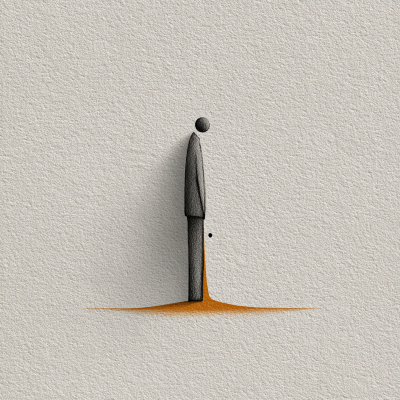
I’m struggling to describe the feeling without sounding overly dramatic or increasingly paranoid, of which it is neither. It’s quieter than that. Stranger, too, if I’m honest. It’s the sense that even when no one is watching me, something is still registering what I’m doing. As if my life is being lightly annotated in the background.
Either that, or I’m being haunted by a dead relative…
I think it’s a reaction to us living much more of the ordinary, boring parts of our lives, in public. What we eat. How we train. What we read. Where we go. What we think. Even when we’re alone, I’ve noticed that this context doesn’t fully switch off.
Visible by default.
I notice it in the most ordinary of places. In the gym, for example. There are workouts I enjoy because they leave me satisfied and exhausted. And there are workouts that look better. Cleaner. Easier to justify. Easier to share on social media (for example). I catch myself leaning toward the second kind more often than I’d like, even when no one else is involved. Not because I’m trying to impress anyone, but because it’s simpler to account for, and fits in better with today’s show first nature.
The same thing shows up when I’m working. I’ll prioritise something that looks productive, sounds sensible and fits neatly into a narrative of progress, even when I know there’s another piece of work that would feel more alive, more absorbing, but harder to explain, and ultimately more boring. Harder to summarise. Harder to point to and say, this is what I did today.
I was on my daily podcast walk on Friday last, and I found myself thinking “I’ve shared the benefits of this activity, and the structure it’s part of, so I need to complete it…” Rather than just completing the walk, I was running the process through the invisible filter of legibility.
This isn’t about social media alone. I think it runs much deeper than that. Even in private, we’re increasingly conscious of how our choices would read if they were ever brought into the light. We make decisions with an imagined observer hovering somewhere just out of frame. Someone who wants things to add up. Someone who expects coherence.
Over time, that changes how we live.
The more you perform your life, the less you actually participate in it.
You still do the things. You still make the good choices. You still move the needle forward. But there’s a layer of distance between you and what you’re doing. You’re slightly outside the experience, tracking it, framing it, making sure it makes sense.
Everything is explainable. Everything is defensible. Everything has a reason.
And yet, something in it feels oddly hollow.
You can look at your day and point to plenty of sensible decisions. You worked. You exercised. You replied to messages. You did things that should add up to a feeling of progress. And yet by the evening, there’s a flatness there. Not sadness exactly. More like a quiet disconnection from what you’ve just lived. I think part of that comes from how much monitoring is now baked into ordinary life. Keeping half an eye on yourself takes energy. Even when nothing is being posted or shared, there’s still an internal accounting going on. Was that a good use of my time? Does this fit the version of me I’m trying to be? Would this choice make sense if I had to explain it later?
The constant self-checking slows everything down just enough to make it heavier than it needs to be. You’re not only doing the thing, you’re also narrating it, justifying it, tidying it up in your head. Never truly present in the moment.
There’s a danger, I think, that over time even good habits start to lose their depth. Exercise becomes about outcome rather than experience. Work becomes about visibility rather than absorption. Rest becomes something you schedule instead of something that actually restores you. You’re still participating, but you’re also standing slightly to the side, watching yourself do it. I imagine this almost like having a lifeguard sitting high above my shoulder, checking everything I’m doing is clean enough for public consumption.
A low-level restlessness that doesn’t seem to respond to more stimulation or more optimisation.
A loss of immersion.
The flow state (an optimal state of consciousness where you are completely immersed, focused, and energized in an activity, often resulting in peak performance and a loss of time awareness), which is the feeling I look forward to the most and actively chase, becomes rarer. Self-observation counteracts the immersion I crave so deeply.
I can’t sink fully into something while also tracking it.
So instead, I feel I’m skimming across the surface of my own life. I move from one explainable action to the next, collecting reasons, maintaining coherence, keeping things neat and tidy. Everything runs how it should, I complete my daily tasks. But satisfaction thins out all the same.
And it’s that satisfaction that I miss the most.
I don’t believe we suddenly lost the ability to enjoy things, or became shallow, or forgot how to be present. Something around us changed, and we adapted to it without ever really noticing.
Over the last decade, more and more of life has become observable. Not just public in the obvious sense, but trackable. Comparable. Summarisable. Activities now come with an implied audience, even when no one is actually watching. A run has a route. A workout has numbers. A walk has a podcast attached to it. A thought becomes a post before it’s finished forming in the mind.
Psychology has a useful frame for this. Research into self-monitoring shows that the more aware we are of ourselves as objects of attention, the harder it becomes to stay immersed in what we’re doing. Attention splits. One part of you is inside the activity. Another part is hovering just outside it, noting, evaluating, contextualising.
Studies on flow states, particularly Mihaly Csikszentmihalyi’s work, are clear on one thing; deep satisfaction requires absorption. The moment you become self-conscious, immersion weakens. You don’t ever fall out of the experience completely, but equally, you never fully settle into it either.
Now place that inside a culture that rewards visibility.
Social platforms don’t just show us what other people are doing. They teach us what counts. What looks like effort. What reads as progress. What can be quickly understood and approved of. Over time, that changes the internal criteria we use to choose how we spend our days.
We don’t start asking, “What do I actually want to do?”
We start asking, without words, “What fits?”
What fits into a feed.
What fits into a narrative.
What will fit into an algorithm.
What fits into a sense of forward motion that can be recognised by our peers.
The brain is very good at learning reward patterns. Dopamine doesn’t respond to meaning in the abstract; it responds to feedback. Likes, metrics, completion markers, visible outputs, these are all short feedback loops. They feel satisfying in the moment, even when the activity itself is thin.
Over time, this rewires preference.
You begin to favour activities that close cleanly. Things that can be ticked off, shared, or summarised. Things that give you a sense of having done something, even if they didn’t hold your attention while you were doing them.
What I’ve noticed is that the slow things, the personal things, the absorbing-but-unspectacular things have started to become less enjoyable, because they don’t offer me any feedback, and honestly the whole thing is just exhausting.
I’m expending energy, but not entering states that replenish it. I’m active, but I’m rarely immersed. Engaged, but rarely absorbed. My days, on paper at least, are productive and I’m moving forward, both on a personal level, and with protocol, but they can feel strangely weightless while they’re happening.
We’re living inside systems that pull attention outward and reward legibility over presence.
If this is happening to you, and you recognise yourself in this letter, I want you to know; Nothing is wrong with your discipline. Nothing is wrong with your values. And nothing is wrong with your capacity for meaning.
This flat, exhausting, performative feeling isn’t a personal failure at all. It’s a predictable response to a world that keeps asking you to stand slightly outside your own life and make sure it reads properly to others.
Be present. Exist inside yourself instead of watching yourself exist.
Take Care
- James