I am the Danger.

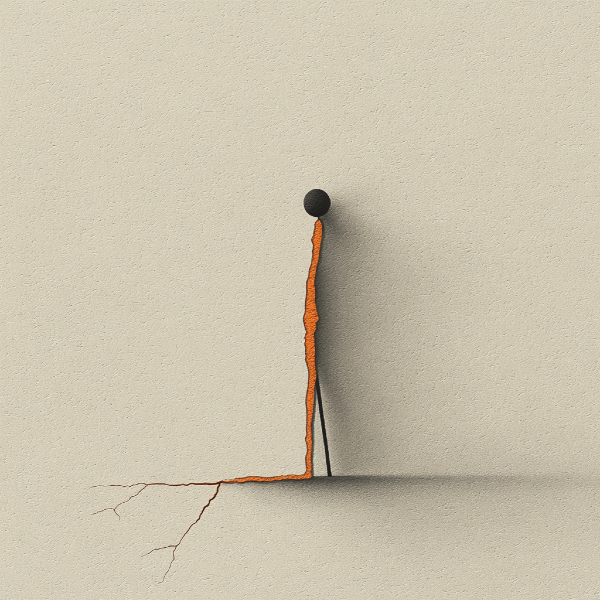
I am forty-three years old.
I’m a writer, and a speaker, and can increasingly be filed under ‘content creator’, a phrase I feel slightly ridiculous about. I find dry, observational humour the funniest but I’ve always been fond of a dick-joke. I’ve grown very tired of sarcasm. Politically, I am a lefty, with strong socialist values, which I refuse to apologise for, or soften in a room where they are unwelcome. I don't drink to excess anymore. I have no interest in hard drugs. I value loyalty, directness, and people with ambition. I train 5 days a week with very little room for compromise. My diet could always be better. I have developed a deep self awareness, and a single mindedness, both of which can be an enormous blessing, and when I allow it, a massive pain. I struggle with people who are performatively miserable, chronically passive, or rude. I am not interested in bigotry in any form. I have an overweight cat, Ralph.
The paragraph you just read took me two decades to write.
Not literally.
But the capacity to write it, to sit down and describe myself cleanly and easily, without checking it against whoever might be reading is very recent for me. Five years ago I couldn't have done it. Three years ago, I would’ve struggled. For most of my adult life, I have been several different people depending on the room I walked into and I had so completely normalised the switching that I didn't notice the exhaustive weight of it until I put it down.
It’s called code-switching.
There's a concept in psychology called self-monitoring, which was first described by Mark Snyder in 1974 - that measures the degree to which people observe and regulate how they present themselves in social situations. High self-monitors are highly attuned to social cues. They adjust their behaviour, their opinions, even their apparent values depending on who's in the room. They are, in many contexts, excellent company. Likeable. Readable. Adaptable. You probably know a few. Maybe you are one yourself?
They are also, over time, losing sight of themselves.
Snyder's research found that high self-monitors maintain greater social flexibility but at a significant cost to their internal consistency. They find it harder to describe themselves with conviction. They bend and mold to their surroundings. They report lower levels of what psychologists call self-concept clarity, the degree to which you have a clear, stable, coherent sense of who you are. And self-concept clarity, it turns out, is a BIG deal. It's strongly correlated with psychological wellbeing, resilience under stress, and the ability to make decisions with confidence.
In other words; if you don't know who you are, everything gets harder.
Which brings us back nicely to me. A different hat for every occasion. And every version had just enough truth in it to feel sustainable and just enough of me in the performance that I could maintain it without total and utter collapse.
What I didn't understand until I sat down to write this letter, was the cumulative toll it had taken.
Low self-concept clarity is directly linked to higher neuroticism, lower self-esteem, and reduced psychological stability. People who struggle to describe themselves consistently don't just feel confused - they feel anxious, reactive, and weirdly exhausted in ways they can't immediately attribute to anything specific.
This is because the exhaustion doesn't really have a name. It just is.
Every act of self-regulation (every moment of adjusting your presentation, moderating your instincts, or performing a version of yourself) draws from a limited pool of psychological resource. The more you self-monitor, the more depleted you become. And the more depleted you become, the more you depend on external cues to know how to behave, because the internal signal has gone too faint to hear clearly.
I learned an awful phrase whilst researching all of this - self-erosion. A slow dimming of the original version. You actually start to lose the ability to distinguish between what you actually think and what you've learned to say. Your instincts become unreliable because you've overridden them so many times that you've learned to just ignore them, and they've learned to stay quiet.
There's a film from 1996 called Multiplicity. Michael Keaton plays a man so overwhelmed by the competing demands of his life that he decides to clone himself - one clone for work, one for home, one for everything else. It starts as a solution. It ends as a horror film. Because when the clones start copying each other, each generation becomes more degraded, distorted and less recognisable than the last.
That's what sustained self-monitoring does. Every version you perform is a copy. And copies of copies lose resolution and clarity. The further you get from the original, the more instincts you've overridden and the more versions you've maintained simultaneously, the harder it becomes to find the signal underneath all the noise.
You become, in the most functional sense, estranged from yourself.
The type to spend a disproportionate amount of time thinking about who they are. Reading things that might clarify it. Taking personality tests, palm reading, checking what Mercury being in retrograde might explain about the week they just had, noting which parts feel accurate. Relieved when any framework, however thin, seems to explain them to themselves. Gravitating toward conversations about purpose and direction, not because they're self-obsessed, but because the question feels genuinely unresolved. Watching people who seem settled in themselves, who confidently order at the restaurant without deliberating, who disagree without apologising, who leave rooms without reviewing how they did, and feeling the gap between themselves and that person as something specific, even if they couldn't name it
That's not a character flaw, but it is certainly worth considering.
There is a version of this that most people will recognise. The version you perform at work , slightly more formal, more agreeable, head down, slightly less honest about what you actually think. Then there’s the insipid version you produce for your partner's family. The version you resurrect for old friends who knew you before, worn like a costume at Christmas. None of these feel particularly dishonest in the moment. They feel like mature consideration or social intelligence.
It’s easier this way.
This is not to say that reading a room is not important. Adjusting your register for context is not the same as abandoning yourself.
Have you ever left a room and felt relieved? Walked away from a conversation and felt vaguely ashamed of what you said, or didn't say? Found yourself reviewing your own performance afterward, calculating whether you came across correctly? There might be a gap between the version that showed up in the moment and the one that exists when nobody's watching.
There's a moment in Breaking Bad where Walter White, having spent three seasons maintaining separate versions of himself for every situation he finds himself in - the teacher, the husband, the scientist, the criminal, finally concedes. He stares across the room at his horrified wife and with all the confidence of a man that’s finally stopped pretending, says, "I am the danger." It's the moment all the Walter white’s collapse into one. Horrifying in context (RIP Mike Ehrmantraut) but you have to admire the clarity.
He finally knows who he is.
What I know is that the more I build a life around structure, around training, around the work and around a set of values and principles I am proud to be living, the less I need to adapt. And in the process, the answer to the question of who I am has become non-negotiable.
Self-trust, built through behavioural evidence rather than belief, does something specific to the self-monitoring problem. It gives you a reference point. When you consistently do what you said you would do, you build an increasingly solid and clear account of yourself. Your values stop being abstract. They are demonstrated. And demonstrated values are much harder to argue with.
I am far from complete. There is more to me than thirteen sentences, and more still is becoming clearer to me. But the capacity to write my bio in one sitting, with no editing, to say “this is who I am,” without a second version running underneath to make it more palatable, that's new.
The question isn't who you want to become. Starting with identity is the wrong order. You don't think your way into knowing who you are.
You behave your way there.
Take Care
- James