Why Does Their Progress Feel Like Your Failure?

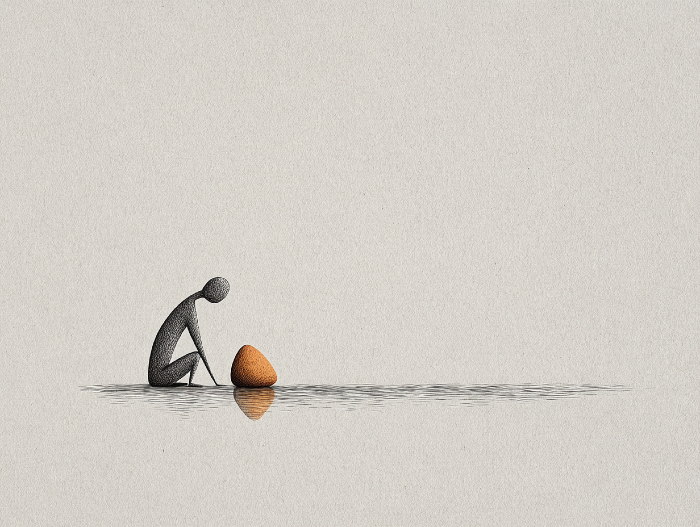
There's another writer in my space, I won’t name him, but I’d be confident he’s popped up on your FYP. He does the same kind of work, in the same territory, on the same small corner of the internet. He’s very confident and articulate. He posts daily. He writes well. He's launched a speaking career. He's also fifteen years younger than me.
Another rooster in the henhouse.
To be clear, and in case he ever stumbles across this (he won’t), I find him genuinely inspiring. I've read letters of his that have caused me to sit up and take notes and I’ve replayed videos he’s posted, hoping that some of his natural charisma will rub off on me. And yet every time I open the app and see his name, before the admiration, there exists inside me a small internal flinch. A friendly reminder that I could have started this years ago. That I did start years ago, in some form, and just let it die. That the thing he's doing at thirty (I daren't check his actual age), I'm doing at forty-three, and the maths of that is not lost on me.
That small internal flinch is the subject of this letter.
Because it isn't about him. It was never about him. He's just doing the thing I didn't do soon enough. And apparently, that's enough for my silly brain to build a fucking league table out of it.
Comparison is not only the thief of joy, it's also the thief of pace, direction and nerve.
Comparison doesn't hurt because the other person is doing well, it hurts because once you’ve noticed them (thankyou META algorithm), you subconsciously consent to be measured against their timeline. Their pace becomes the benchmark. Their output becomes the standard. Their arrival becomes the proof that you're somehow behind. And the truly shit part is that you never actually decided any of that - it simply happened somewhere between the scroll and the flinch, faster than thought.
You've imported a metric you didn't choose. And now you're losing a game you didn't enter.
I also have previous where this is concerned…
At drama school, I was surrounded by people who were, frankly, better than me. They were sharper, wittier, more instinctive, more technically fluent. I spent three years watching them get better and better, absorbing the curriculum with as ease I could only dream of - Shakespeare, Brecht, Chekov. I took it personally in the way that only a twenty one-year-old with a fragile ego can. I considered leaving on more than one occasion, a combination of my first foray into the world of panic attacks, and the constant mid-table placement I had given myself. I thought about picking a different life constantly. I spent more time measuring myself against them than I did getting better at the thing I'd gone there to learn.
And then something useful happened. I graduated. And once I was out of that building, away from those talented, adaptable people, I stopped comparing and I started working. I took the craft a lot more seriously than I had when I was surrounded by people I was trying to outrun. Within a few years, I'd had more opportunities than most of them combined. Not because I'd overtaken them, that's the wrong frame, but because I'd stopped playing this stupid competitive game and started building my own.
The comparison didn't make me improve. Leaving it did.
Here's what I've come to understand, now that I'm watching the same loop run again with a different cast.
Without a scoreboard of your own, every person further along is a referendum on your worth. You see them, you quickly work out how far ahead of you they are, and because you have nothing to measure your own progress against, the gap becomes the title of the story. Their pace sets the tempo. Their milestones define the calendar. You're not running your life; you're marking yourself against someone else's.
This is why social media is so specifically damaging for people without clear internal metrics. Research on passive versus active social media use - the work by Philippe Verduyn, Ethan Kross and others at Michigan and Leuven, shows consistently that passive scrolling correlates with reduced wellbeing, while active engagement doesn't. The mechanism is exactly what it sounds like; when you scroll, you absorb other people's outputs without producing anything of your own. You import, and import, and for good measure, you import some more, and publish nothing of your own. By the end, you've measured yourself against thirty strangers and produced nothing to measure back.
Festinger's original social comparison work from 1954 adds the specific blade. Comparison doesn't hurt equally across the board. It cuts deepest when the other person is similar to you - same field, same lane, same general shape of life. Strangers in completely different lives barely register, but someone doing the exact thing you wanted to do, fifteen years ahead of schedule, is the worst-case scenario the theory predicts. Which is where I’ve found myself recently.
To reiterate; none of this is a problem if you have your own scoreboard. If you know what you're building, at what pace, toward what shape, you can look at someone further along and simply read the map. Extract the lesson. Note the technique. And move on. Their progress becomes information rather than judgement. But strip the scoreboard away, and the same data becomes evidence that you've fallen behind on a race you never agree to enter.
The younger writer only stings me because there is still a part of me quietly measuring by a metric I haven't fully claimed. The flinch is the usual diagnostic here. It tells me where my own scoreboard is incomplete.
The trap most people fall into here is assuming the answer is to stop comparing. Just stop scrolling. Stop looking. Build discipline around not noticing.
Good luck with that.
You live in the digital world. You will see other people. You will notice their wins. Trying to engineer an environment where comparison is impossible is a form of avoidance, not strength - it just means the first comparison that does get through will hit even harder because you've lost the tolerance for it.
The work is not to stop looking. The work is to know what you're measuring before you look.
If you don't know what you're building, any evidence of someone else's building will feel like a verdict on your own progress. If you do know, that same evidence becomes something you can use, ignore, or steal from. The scoreboard simply helps metabolise the flinch into something other than shame.
There's a cost to this, and I'll name it as best I can; Building your own scoreboard is slow and deeply uncinematic. It isn't a scroll-deletion or a digital detox or a morning affirmation about running your own race. It's the far less exciting work of deciding, in specific terms, what you're actually trying to build, what counts as a good week, what you're tracking, and what you're ignoring. It's mundane. It's quiet. It looks nothing like the breakthrough you were hoping for.
But the alternative is to keep running someone else's race with their stopwatch, pretending it's yours, and wondering why you keep finishing second in a game you weren't signed up for.
You will never stop noticing other people. That isn't the goal here. The goal is to notice them from a position where their progress has no jurisdiction over your own.
Comparison without a scoreboard is self-harm. Comparison with one is calibration.
Take care
- James