Stop Being Programmed

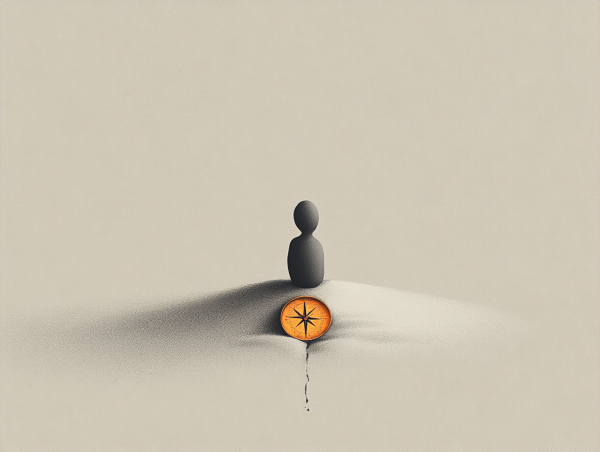
You’re told what to think from the day you’re born.
Parents, teachers, religion, media, social circles, algorithms - they all hand you opinions, identities, enemies, heroes.
No one sits you down and says:
“This is how you test an idea before you let it inside your head.” Critical thinking isn’t academic. It’s a survival skill...
A few years ago, I campaigned for Jeremy Corbyn, the then leader of the Labour party.
I liked his manifesto. I felt, and still do, that it was exactly what the UK needed. I liked the energy around him. Here was a man who has spent his life campaigning for the marginalised, which spoke to the socialist in me. I liked the idea of someone “for the people” taking on a broken system.
So I did what a lot of people did; I shared his speeches, offered him my vocal support on social media, defended him in conversations, and dismissed the allegations of antisemitism in his Labour Party as a smear campaign and a witch hunt.
I told myself I was being principled. Standing up for a man who was standing up for my people.
I wasn’t thinking critically.
An independent investigation by the Equality and Human Rights Commission later concluded that the Labour Party under his leadership had committed unlawful acts of harassment and discrimination against Jewish members and had serious, systemic failings in how it handled antisemitism complaints.
The facts were available. I just didn’t go looking for them.
I liked the story more than I cared about the truth.
That’s what this essay is about.
Not Corbyn. Not Labour.
It’s about the way a mind can be certain and wrong at the same time.
You’re told what to think from the day you’re born.
Parents, teachers, religion, media, social circles, algorithms - they all hand you opinions, identities, enemies, heroes.
No one sits you down and says:
“This is how you test an idea before you let it inside your head.”
Without that skill, your life turns into a loop of reactions. You react to headlines, trends, authority, or emotion. Thought becomes imitation. Opinion becomes identity. And identity is everything.
Critical thinking isn’t academic. It’s a survival skill.
It’s the difference between:
- acting from clarity
- and being controlled by whatever story hits you hardest that day.
Once you start thinking properly; questioning, verifying and zooming out, you realise how much
of what passes for “truth” is just repetition and emotion dressed up as certainty.
The Mind Gets It Wrong
The brain is brilliant, but it’s not built for the modern world.
It burns a ridiculous amount of energy, so it saves effort wherever it can. It relies on shortcuts; patterns, habits and quick associations, to get through the day. Psychologists call these heuristics and biases.
These shortcuts were useful when life meant “avoid the lion, find the food, keep the tribe happy.” They’re less useful when life means “decide who to vote for based on a 12-second clip on TikTok.”
A few things go wrong straight away.
1.1 Fast Thinking vs Slow Thinking
Daniel Kahneman talks about two modes of thinking:
Fast: automatic, emotional, effortless.
Slow: deliberate, analytical, energy-intensive.
Fast thinking is what reacts to a headline in half a second.
Slow thinking is what actually checks if it’s true.
Most of the time, life runs on fast thinking. You couldn’t function if you analysed every decision. But when fast thinking is in charge of beliefs - politics, health, identity, and relationships, that’s where damage happens.
Fast thinking isn’t evil. It just doesn’t care for accuracy.
It cares about speed, safety, and coherence.
“Does this match what I already believe?” is often more important than “Is this real?”
1.2 Why Bad News Hits Harder
Psychologists have shown that negative information hits harder and sticks longer than positive information. It’s called the “negativity bias.”
- One criticism outweighs ten compliments.
- One scandal wipes out years of quiet good work.
- One shocking story about “waves of migrants” lodges deeper than a thousand boring graphs about actual numbers.
From an evolutionary perspective, this makes sense. Missing a threat could kill you. Missing an opportunity probably didn’t.
But now that very same wiring makes you overreact to bad headlines, angry tweets, and viral outrage. Your emotions get triggered, long before truth has a chance to catch up.
1.3 How Emotion Hijacks Thought
So, the emotional part of the brain reacts first. Fear, anger, disgust; those are quick. The slower, rational part of the brain only comes online after the emotional surge.
By the time you think, you’re already leaning towards a conclusion.
You don’t examine the story; you justify it.
Newsrooms, campaigns, and advertisers understand this perfectly;
- Headlines are written to trigger threat and outrage.
- Political slogans are designed as emotional shortcuts.
- Social media rewards content that keeps you in a heightened state.
An outraged mind can’t think. It can only react.
Ask yourself:
How many times have you felt furious about a story you never actually researched?
1.4 Corbyn and the Witch Hunt
When I defended Jeremy Corbyn, I told myself I was being rational.
I liked his policies on inequality, the need to bring our utilities back into public ownership, his desire to fix our homelessness crisis, and moreso, the hope that he offered a fractured, broken country, and the systems that ran it. I saw him as a counterweight to a cruel, cynical politics.
When antisemitism stories surfaced, I told myself: This is just the establishment trying to destroy a threat.
I did two things:
- I minimised or dismissed the claims as exaggeration or smear (confirmation bias doing
its thing). - I actively defended him in conversation and online, repeating the “witch hunt” narrative without reading the primary evidence.
Then the Equality and Human Rights Commission published its report in 2020. It found:
- Unlawful acts of harassment and discrimination for which the Labour Party was responsible.
- Serious failings in leadership and systems for handling antisemitism complaints.
Independent. Legal. Statutory.
Not a Twitter thread. Not a cheap headline. Not a smear piece in the Telegraph. A full investigation.
I was embarrassed. I felt let down. Deceived. But was that really the case? Or had I just not engaged my critical mind?
I have to admit; I didn’t avoid the evidence because it was weak. I avoided it because it threatened a story I liked.
That’s what an untrained mind does. It protects belief, not truth.
Critical thinking begins when you start paying attention to that move.
2. The Anatomy of a Thought
A thought feels like a fact.
It isn’t.
It’s a story the brain tells itself about reality.
To understand that story, you need to see how a thought is built.
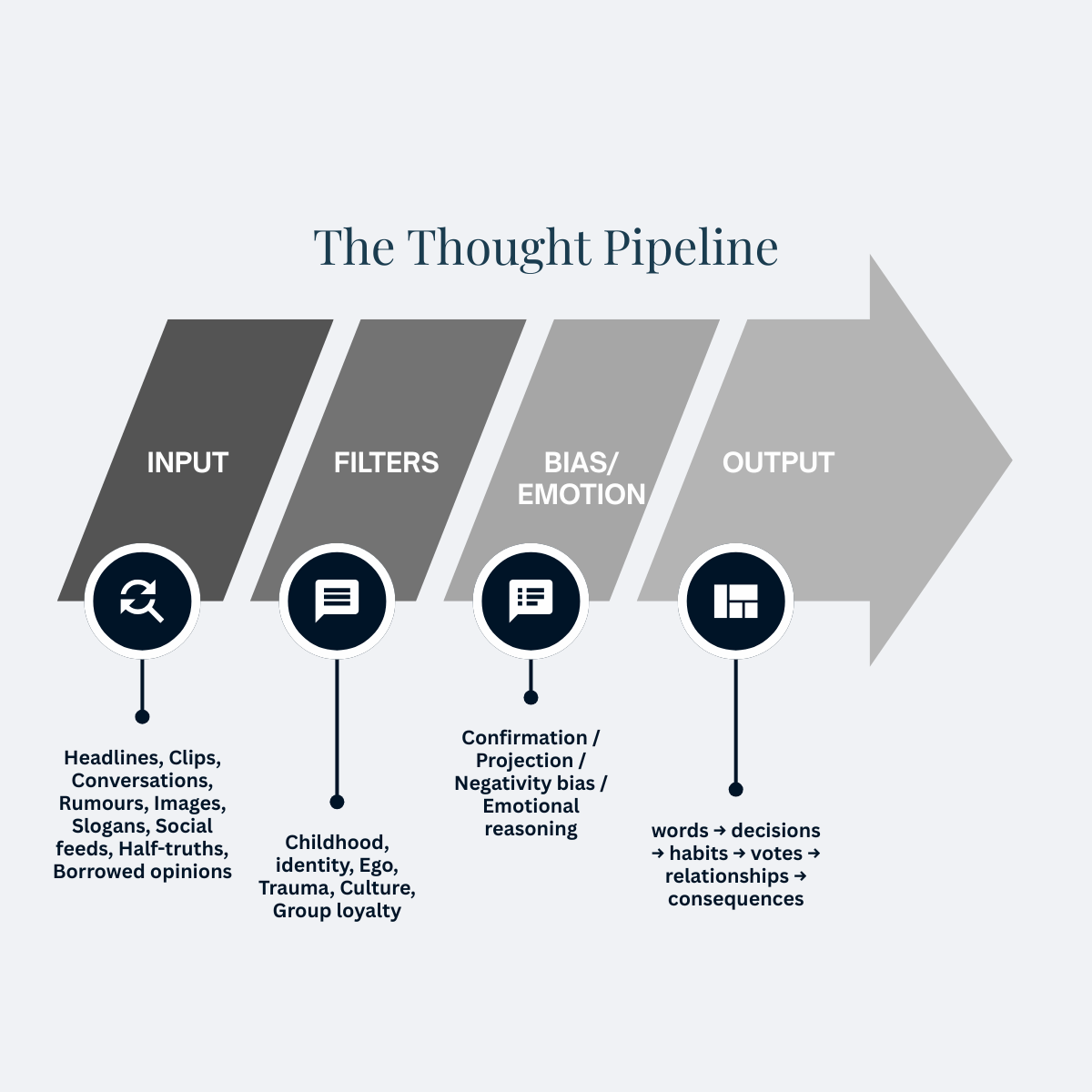
2.1 Input - What You Let In
Every belief begins with information: conversations, headlines, images, clips, books, posts.
Your attention is the front door to your mind. Whoever controls your attention, controls what gets into your head.
We live in an attention economy, where:
- Platforms are optimised for engagement, not accuracy.
- Outrage holds attention better than nuance.
- Simple stories beat complex truths.
If your informational diet is built on short-form outrage, partisan feeds, and unexamined “hot takes”, your worldview will match. Not because you’re stupid, but because you’re being blasted with low-quality inputs, all day, every day.
You wouldn’t expect to build a healthy body on crisps and vodka.
You can’t build a healthy mind on clickbait and bad faith.
2.2 Processing - The Filters You Forget You Have
Once information gets in, it isn’t processed in a clean lab. It passes through layers:
- childhood experiences
- cultural norms
- past hurts
- ego
- identity
- group loyalties
- trauma
- insecurities
If you grew up needing validation, you’ll lean towards stories that make you feel right or virtuous.
If you grew up in chaos, you may prefer strong, simple narratives - good vs evil, us vs them.
Psychologists talk about schemas: mental templates built over time. New information is squeezed to fit these templates. If it fits, it’s accepted fast. If it clashes, it’s rejected or twisted.
There’s another problem: the illusion of understanding.
Studies by Rozenblit and Keil showed that people routinely believe they understand complex systems (like how a toilet, a bicycle, or a political system works) far more than they actually do. When asked to explain in detail, their confidence collapses.
You see a headline about “fixing the NHS” and feel like you get it.
Ask yourself to explain, in detail, how funding, staffing, training, and regulation interact, and things can fall apart quickly.
We confuse familiarity with understanding. That’s a very dangerous mix.
2.3 Output - How Thought Turns into Life
Finally, thoughts turn into:
- words
- decisions
- habits
- social media posts
- votes
- relationships kept or ended
If the input is noisy and biased, and the processing is automated and unexamined, the output is chaos dressed up as conviction.
The problem isn’t that people are irrational.
The problem is they rarely audit how their thinking is produced in the first place.
Critical thinking starts where automatic thinking ends. The moment you pause and ask:
- “Where did this come from?”
- “What’s shaping this reaction?”
- “What would actually make me change my mind?”
That’s when the circuitry starts to rewire.
3. The Tools of a Critical Thinker
Critical thinking isn’t about being negative or contrarian.
It’s curiosity + discipline.
You stay open to new ideas and opinions, but you don’t swallow everything you’re fed.
Here are the core tools, expanded and laid out for you.
3.1 The Pause
Reaction is emotional. Thought needs space.
Between stimulus and response, there’s a tiny gap. This gap is where reason lives.
Most of the damage in life happens because that gap is ignored.
- You see a post, feel attacked, reply in anger.
- You read a headline, feel righteous, share it.
- You hear a rumour, feel vindicated, repeat it.
A practical rule:
When something spikes your emotion; especially anger or fear - pause.
Ten seconds.
Three breaths.
Then ask:
- “What else could be going on here?”
- “Why might someone want me to feel this way?”
It sounds small but it isn’t. That pause is a pattern interrupt. It stops your nervous system dragging you into automatic behaviour.
3.2 The Source Test
Every claim has an author. Every author has incentives.
Before you decide if something is true, ask:
- Who’s saying this?
- What do they gain if I believe it?
- What’s their track record of being accurate or fair?
- Are they selling something - a product, a party line, a persona?
This applies to politicians, pundits, creators, activists, “experts”, anonymous accounts, friends, and yes, even people you like.
With Corbyn, I didn’t do a proper source test. I let my dislike of his opponents, and my sympathy with his policies, do the heavy lifting. I judged the messenger (mainstream media, biased newspapers, centrists, Tories) and threw out the message.
Proper thinking asks:
“If this same evidence came from someone I like and trust, would I suddenly take it seriously?”
If the answer is yes, the problem isn’t the evidence. It’s your bias.
3.3 The Frame Flip
Every argument lives inside a frame - a choice of language and angle.
- “Invasion of migrants”
- “Crisis at the border”
- “War on motorists”
- “Snowflake generation”
These aren’t neutral descriptions. They smuggle in a story.
Frame flipping simply means: rotate the picture.
- What would this look like if I was on the other side?
- What language would they use?
- What facts are invisible from this angle?
If the story still holds up from multiple angles, it’s stronger.
If it collapses the moment you change the frame, it was never solid to begin with.
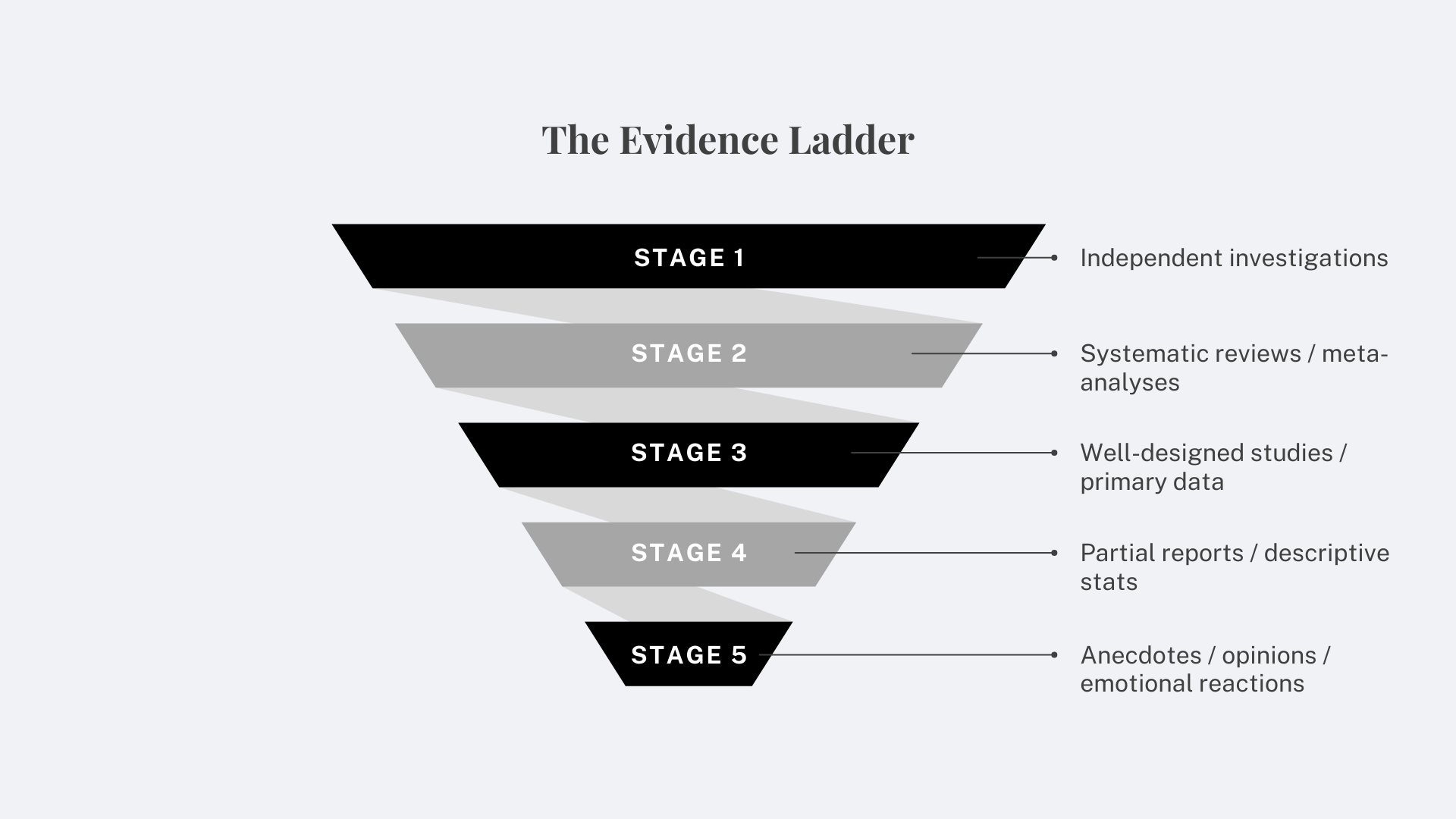
3.4 The Evidence Ladder
Not all information sits at the same level.
At the bottom:
- opinions
- feelings
- anecdotes
- “my mate said”
In the middle:
- descriptive stats
- small studies
- partial reports
At the top:
- systematic reviews
- well-designed studies
- independent investigations
- verifiable primary sources
When the EHRC investigated Labour antisemitism, it wasn’t a tweet. It was a formal statutory inquiry, with legal powers to demand evidence, concluding that Labour had committed unlawful acts of harassment and discrimination against Jews.
That sits far higher on the ladder than:
- “I haven’t seen any antisemitism personally.”
- “My friend in the party says it’s exaggerated.”
- “The media are out to get him.”
Critical thinking doesn’t demand you read every 100-page report. It does demand that you respect the difference between ‘vibes’ and verified evidence.
3.5 The Consistency Check
A belief isn’t just “do I agree with this?”
A better question is:
“Does this belief actually line up with the rest of how I say I see the world?”
If you claim to care about equality, but wave away antisemitism because it’s politically inconvenient, that’s a consistency problem.
If you say you want honesty from politicians, but give “your side” a free pass on lying because you like their policies, that’s a consistency problem.
The mind hates cognitive dissonance, so it will quietly twist reality to restore comfort. Critical thinking does the opposite: it invites the discomfort in.
You don’t need to be a genius to think clearly. You just need honesty.
Honesty about your own bullshit first.
4. Reprogramming the Mind
Thinking critically isn’t a one-off revelation. It’s consistent maintenance.
Your mind is like software. It’s constantly being updated by;
- news cycles
- cultural shifts
- experiences
- friendships
- platforms
If you don’t consciously update it, the loudest, most repetitive inputs will do it for you.
4.1 Information Diet: Less Junk, More Depth
Short-form content has its place. But it’s structurally hostile to nuance. There’s no space for caveats, context, or “we don’t know yet”.
Studies on attention and information overload show that constant exposure to fragmented, high-arousal content increases stress, lowers focus, and pushes people towards quick, emotional judgments.
You don’t need to become a monk. You do need to stop eating mental junk all day.
Practical shifts:
- More long-form essays, fewer reaction clips.
- More books and reports, fewer stitched outrage videos.
- Follow accounts you disagree with but respect. That word matters. Not trolls. Not bad-faith actors. People arguing the other side sincerely.
4.2 Question Design
The quality of your thinking is limited by the quality of your questions.
Lazy questions:
- “Is this true?”
- “Are they lying?”
- “Whose side am I on?”
Better questions:
- “Under what conditions could this be true?”
- “What would I need to see to change my mind?”
- “What’s missing from this picture?”
The first set keeps you locked in yes/no tribal reactions.
The second set opens the door to nuance.
4.3 Belief Maintenance
Treat your beliefs like code. They need refactoring.
Once in a while, take out your notes app and list what you currently believe about:
- politics
- economy
- your country
- health
- relationships
- yourself
Then ask:
- “Where did this belief come from?”
- “What would it cost me to change it?”
- “Has any new evidence appeared that I’ve ignored because it’s inconvenient?”
Beliefs that never move aren’t a sign of strength.
They’re usually a sign that identity has welded itself to opinion.
5. The Critical Thinking Protocol - Rewiring the Mind
Critical thinking isn’t a mood. It’s a discipline of awareness.
You train it the same way you train a muscle; through resistance.
Resistance to assumptions, to impulses, to the easy answer that flatters you.
This isn’t about “thinking harder”. It’s about building habits so that clear thought becomes the default, not the exception.
5.1 The Cognitive Warm-Up - Recognise the Bias
Every mind comes with default settings. Four of the big ones:
CONFIRMATION BIAS
The tendency to search for, interpret, and remember information in a way that supports what you already believe.
It filters reality so you only see evidence that agrees with your existing worldview, while ignoring or downplaying anything that challenges it.
It feels like certainty. It’s actually blindness.
AUTHORITY BIAS
The tendency to take statements as true simply because they come from someone perceived to be an authority - a doctor, a celebrity, a politician, a creator with a big following.
Confidence, status, and presentation are mistaken for competence.
Evidence gets replaced by hierarchy.
PROJECTION
The mind’s habit of attributing your own thoughts, motives, insecurities, or intentions to someone else.
If you’re angry, you assume they’re angry.
If you fear rejection, you interpret neutrality as hostility.
Projection turns your inner world into a filter you mistake for reality.
EMOTIONAL REASONING
The belief that feelings are facts.
If something feels threatening, you assume it is threatening.
If you feel guilty, you assume you’ve done something wrong.
Emotion becomes the evidence, even when no external proof exists. It’s what lets outrage, fear, and insecurity override logic.
Training drill:
If you find yourself making a fast judgement, write it down;
- “He’s an idiot.”
- “She’s fake.”
- “That’s definitely true/false.”
Then label which bias was probably involved.
Over time, you start catching the bias in real time.
You won’t stop having biases. No one does.
You’ll just stop letting them drive the car while you’ve got your eyes shut.
5.2 The Interrogation Loop - Question Every Claim
Philosophers call it epistemic humility; the awareness that you might be wrong.
When you encounter a claim that matters - a statistic, a narrative, an accusation, a promise;
run it through this loop:
1. Source
○ Who said this?
○ What do they gain if I believe it?
2. Evidence
○ What data supports this?
○ Is it a one-off anecdote or a pattern backed by decent studies or investigations?
3. Counter
○ What would the strongest opposing argument say?
○ Have I read it?
4. Context
○ In what situations might this be false, or only partly true?
5. Consequence
○ If I adopt this belief, what behaviour will it justify or block?
This takes minutes. With practice, seconds.
You’re not just asking “is this true?”
You’re mapping the ecosystem around the idea: who it serves, who it harms, what it simplifies.
Carl Sagan had his “baloney detection kit” - a list of questions to poke holes in bad arguments.
This is your updated version for an age of weaponised information.
5.3 The Perspective Flip - Train Cognitive Flexibility
One of the strongest predictors of good thinking is cognitive flexibility - the ability to see an issue from multiple viewpoints without falling apart.
Here’s a drill:
- Take a topic you feel strongly about.
- Write down your current position in a few sentences.
- Then argue the opposite - seriously. No strawmen, no sarcasm.
- Force yourself to find at least three credible sources that support that opposing view.
When you do this properly, something interesting happens:
- Some of your original arguments weaken.
- Some opposing arguments turn out to be nonsense.
- Some points on both sides merge into a more nuanced picture.
You’re not betraying your beliefs. You’re pressure-testing them.
You’re separating “I’m attached to this” from “this holds up”.
Studies on the illusion of explanatory depth show that people’s confidence in their views often drops once they have to explain them in detail. Political extremism in particular is fuelled by the illusion that we understand complex issues we’ve only ever met as slogans.
Flipping perspective exposes that.
5.4 The Knowledge Weight Test - Measure the Evidence
Every belief has load-bearing beams:
- specific facts
- studies
- testimonies
- principles
Write down one belief you hold about something important:
- “The NHS is beyond repair.”
- “Social media is destroying mental health.”
- “I’m bad with money.”
- “Corbyn was unfairly targeted.”
Then:
- List what this belief rests on.
- Try to break each beam. Look for disconfirming evidence as seriously as you looked for confirming evidence.
- If a beam collapses, either replace it with something stronger or admit that belief needs to be softened or dropped.
Karl Popper argued that a theory is scientific if it can, in principle, be falsified - proven wrong.
Treat your beliefs the same way.
You’re not thinking, if nothing could ever prove you wrong, you’re clinging to a belief.
5.5 The Synthesis Habit - Integrate, Don’t Just Collect
Information hoarding isn’t intelligence.
Once a week, look back at what you’ve:
- read
- watched
- argued about
- bookmarked
And ask:
- “What new idea genuinely changed how I see something?”
- “What patterns keep showing up?”
- “How would I explain this week’s learning in one paragraph?”
The Feynman Technique - explaining things in simple language - is powerful because it forces synthesis. If you can’t explain it clearly, you don’t really understand it.
You don’t need to remember everything.
You do need to integrate something.
5.6 The Reflection Audit - Measure Progress
Once a month, run a thinking audit.
- What beliefs have shifted?
- Where did you admit “I was wrong” out loud?
- Have you become more curious or more defensive?
- Are you following more diverse sources than you were three months ago, or fewer?
Thinking is a skill.
Unlearning is evidence that you’re actually using it.
6. The Shift
It can feel humiliating to realise just how often you’ve been wrong.
Wrong about people.
Wrong about yourself.
Wrong about politics, about work, wrong about what you thought others thought of you.
I’ve misjudged people at both ends.
Written some off as lost causes, only to watch them grow into exactly the kind of men I wish I’d been earlier.
Put others on pedestals, only to discover they weren’t who I’d decided they were.
I’ve believed abuse and praise with the same uncritical mind.
- When strangers tore me apart online, I let it define me.
- When strangers heaped praise on me online, I let that define me too.
Both are forms of programming
Both are lazy thinking.
Neither is grounded in reality - these people don’t know you, and you don’t know them.
Critical thinking is how you step out of that mess.
Not by becoming numb or cynical, but by becoming precise.
You start to see:
- how advertising manipulates desire
- how politics engineers outrage
- how identity disguises belief
- how your own ego edits out anything that threatens its favourite stories
Once you see the architecture, you can’t unsee it.
That doesn’t mean you become detached from life. It means you move through it with less confusion.
You still care.
You still take positions.
You still vote, argue, change your mind.
You just stop letting your nervous system, your timeline, and your vfavourite tribe do your thinking for you.
Critical thinking won’t make you untouchable.
It will make you responsible.
Responsible for what you let in.
Responsible for what you pass on.
Responsible for the stories you allow to shape your life.
Ownership of your mind is the highest form of freedom you’re going to get in this world.
Everything in this essay is aimed at helping you claim it back.
Take Care,