Future-proof Your Career.

This is a long form piece of work that I have shared before but have never sent out to my newsletter list. If you've ever wanted to build something outside of the ecosystem you currently operate in, share your thoughts, your experiences, and become more than the sum of your parts, I think this might help.
It's based entirely on how I run protocol, from the writing, through to the content creation side. Pair this with some marketing knowledge, research social media metrics and sales funnels, buy a copy of Alex Hormozi's latest book, and get started...
How To Build A Presence
We don’t all crave fame, money, or influence. We want options. We want room to move. The ability to say “no” without fear, to choose a different direction if life demands it, to walk away from things that drain us without the immediate panic of “what else do I have?” We want a life that feels bigger than our shift pattern, our postcode, or the handful of choices we were handed at eighteen.
Sadly, most of us (adults) don’t have options.
Not real ones anyway.
We have responsibilities. We have routines. Bills, dependents, pressures, expectations, and a limited set of escape routes that shrink a little more each year. We didn’t choose this - it just happened. Slowly. Quietly. The world kept moving, and we stayed in place.
You go to work, you do your job, you handle your responsibilities, and none of it exists anywhere beyond the four walls of your daily routine. There’s no record. No proof. No identity being built. No outward expression of the things you think about, care about, or have learned along the way. You feel stuck, not because you’re incapable, but because you’re invisible.
And this is where people get the wrong idea about “creating content.” They hear that phrase and picture influencers, vlogs, forced positivity, perfect lighting, and the kind of performative self-promotion that makes your skin crawl. They assume visibility means becoming someone they don’t respect.
It doesn’t.
Creating content is not about becoming a creator.
It’s about regaining control of a life that has reduced you to maintenance and survival.
Content isn’t performance, it’s agency. It’s the simplest, cheapest, most accessible way to turn the life you already have into something that compounds, instead of something that just… happens to you.
Because when you start publishing - even small things, maybe even once a week - you create movement. You create proof. You create a trail of ideas, insights, observations, mistakes, and lessons that begin to form an identity you can actually grow into. You make yourself findable. You make yourself memorable. You make yourself someone people can trust, because trust requires evidence, and evidence requires visibility.
So many of you try to escape your lives through side hustles, shortcuts, crypto phases, online schemes, new qualifications, new identities, anything that promises a quick shift in direction. But the only path that actually works, consistently, the only one that doesn’t rely on luck, timing, or pretending, is taking the life you already have and making it visible. Turning experience into expression. Turning clarity into language. Turning thoughts into assets.
Visibility doesn’t make you a creator.
It gives you options.
And options are what change a life…
The Economics.
Over the next decade, the job market is going to change dramatically. Not in a sensational, sci-fi way, but in a slow, structural, economic way. Most forecasts agree on one thing: a significant share of routine, administrative, and predictable work will be reshaped by automation and AI. Millions of roles worldwide are now classified as “high automation exposure” by organisations like the ONS, IPPR, and the OECD.
That doesn’t mean everyone is about to lose their job. It means the nature of work is shifting, and the people who adapt early will feel the least friction. The people who struggle won’t be the unskilled - they’ll be the invisible.
Experience still matters. Skill still matters. A CV still matters. But in a noisy, competitive, algorithm-driven economy, being excellent isn’t enough if nobody can see it. Visibility has become an economic multiplier. It doesn’t replace competence, it amplifies it.
When your work is invisible, every new opportunity has to be rebuilt from scratch.
When your work is visible, you carry proof with you - evidence that survives beyond any single employer, job title, or industry shift.
Visibility isn’t a safety net.
Visibility is optionality.
For example; a brilliant fitness coach who has no audience earns less than an average one who publishes weekly. A highly trained consultant loses work to someone with half their expertise but ten times their presence. Even tradespeople, the safest jobs in the automation era, grow faster when they build trust online.
People choose the names they recognise.
Consumers crave clarity.
This isn’t about vanity; it’s simply market mechanics.
We’ve entered a trust-driven economy where buyers don’t ask,
“Who is the most skilled?”
They ask,
“Who do I already know, recognise, or trust?”
That shift is measurable.
Studies from LinkedIn and Edelman show that people are 4–7× more likely to buy from individuals with visible expertise, even when the alternatives are more qualified.
Meanwhile, AI is swallowing huge parts of established knowledge-based work; writing, editing, analysis, research, admin, design, are all under serious threat.
Competence used to be enough to forge a decent career. So did being dependable.
Now it’s visibility. Being ‘findable’. Being the first voice people think of when considering a specific topic.
And in a collapsing job market, the ability to be found is worth more than another qualification on a CV.
You don’t get paid for what you know. You get paid for what people can see you know.
Last year, “solo creators”, that’s, individuals publishing knowledge, experience, and perspective - earned over $250 billion globally, and this figure is projected to hit $480 billion by 2027.² The fastest-growing creators aren’t dancers, comedians, or influencers. They’re experts with a voice. ‘Normal’ people in their 30s, 40s, 50s who publish what they know, turn perspective into proof, and let the internet handle istribution. People just like you.
People just like you.
Ten years ago, building a personal brand required luck.
Now all it requires is a laptop.
You already have everything you need to publish;
- The internet - unlimited knowledge, an entire YouTube library, free mentors, and every skill breakdown imaginable.
- AI - templates, outlines, rewrites, edits, ideas, summaries, scripts. A complete creative
exoskeleton. - Social media - free global distribution to millions.
You’re living in the first era in human history where an ordinary person can turn lived experience into opportunity at scale - all without money, qualifications, or gatekeepers.
To conclude;
The economic landscape is changing fast.
If you publish, you compound.
If you stay silent, you stay invisible.
Visibility is survival.
A personal brand is the modern safety net.
A proven body of work is career insurance.
Publishing doesn’t just make you known, it makes you employable, referable, optional, and economically anti-fragile.
THE ‘CONTENT CREATOR’.
You probably tell yourself you’re “not the kind of person” who builds a presence. The term ‘content creator’ throws up images of wide eyed health gurus, vapid fitness influencers and OnlyFans girls.
You think visibility belongs to people who are louder, more confident, more creative, or more naturally talented than you.
You’ve spent years believing that your work should speak for itself. That if you stay reliable, skilled, and humble, the right people will eventually notice.
You’ve been conditioned to think that being visible is showing off. That talking about your work is arrogance. That staying quiet is noble, respectable and professional.
And it’s cost you opportunities you’ll never even know you missed.
“I don’t know anything people would care about.”
But you do - you just don’t recognise it because you live inside it every day.
The things that feel obvious to you are fascinating to everyone else.
Skills, mistakes, patterns, hard-won lessons, the way you think - that’s your content.
People don’t follow experts. They follow perspective and opinion.
“My industry is boring.”
Most industries are boring.
That’s why anyone who can make sense of them, simplify them, or humanise them becomes valuable overnight.
You don’t need to sell excitement, you can simply start with clarity.
Clarity is rare. And rare things travel.
“I’m not confident enough.”
Confidence isn’t a requirement.
Nobody starts confident - they start unknown.
Publishing is what creates confidence because it gives you evidence:
“I can say things in public and nothing falls apart.”
“Everything has been said already.”
Fair point.
But not by you, from your angle, with your history and your language.
Originality isn’t new ideas - it’s new combinations of ideas, run through your own personal lens.
“What if nobody cares?”
Then you lose nothing.
You’re already invisible.
Publishing only moves you upward:
from ignored → seen,
from seen → understood,
from understood → trusted.
And trust is the new currency.
I can’t teach you how to “be a creator, but I can teach you how to take what you already know, organise it, make it legible, and publish it in a way that builds proof.
And sometimes proof is all you need…
JUST START.
One of the biggest traps people fall into is the belief that they need to feel prepared before they publish anything. They wait for the perfect idea, the perfect angle, the perfect draft, and they end up waiting for years.
I’ve met countless people who talk confidently about their plans, their insights, their “almost-finished” projects, only to discover that nothing ever leaves their notes app. All preparation, no release.
The truth is far simpler: you don’t learn by preparing, you learn by publishing. The world doesn’t punish imperfection anywhere near as harshly as it punishes silence.
Nobody remembers the rough first post, the awkward opening line, or the early experiments.
At some point, you have to choose an idea (we’ll get to that shortly), and put it out into the world. Edit it for clarity, not perfection. Treat every piece like a prototype, something you can improve later rather than something that needs to be flawless now.
Exposure is uncomfortable in the beginning, but it’s also the fastest form of growth. The more often you release something, the quicker the fear dissolves. Confidence doesn’t come from thinking; it comes from doing.
BUILD RHYTHM, NOT GENIUS.
People massively overestimate the importance of brilliance and underestimate the power of rhythm. Momentum will take you further than talent ever will. The people you admire the most in the public sphere, they’re not perfect, nor is their content, but they’re consistent. They have developed a voice, an audience, and a body of work they can stand behind.
Genius isn’t a lightning bolt; it’s a by-product of repetition. You publish enough and patterns start to reveal themselves. You begin to understand what you believe, what resonates, what feels false, and what feels true. You start recognising the difference between writing that comes from honesty and writing that comes from performance. None of this arrives without frequency.
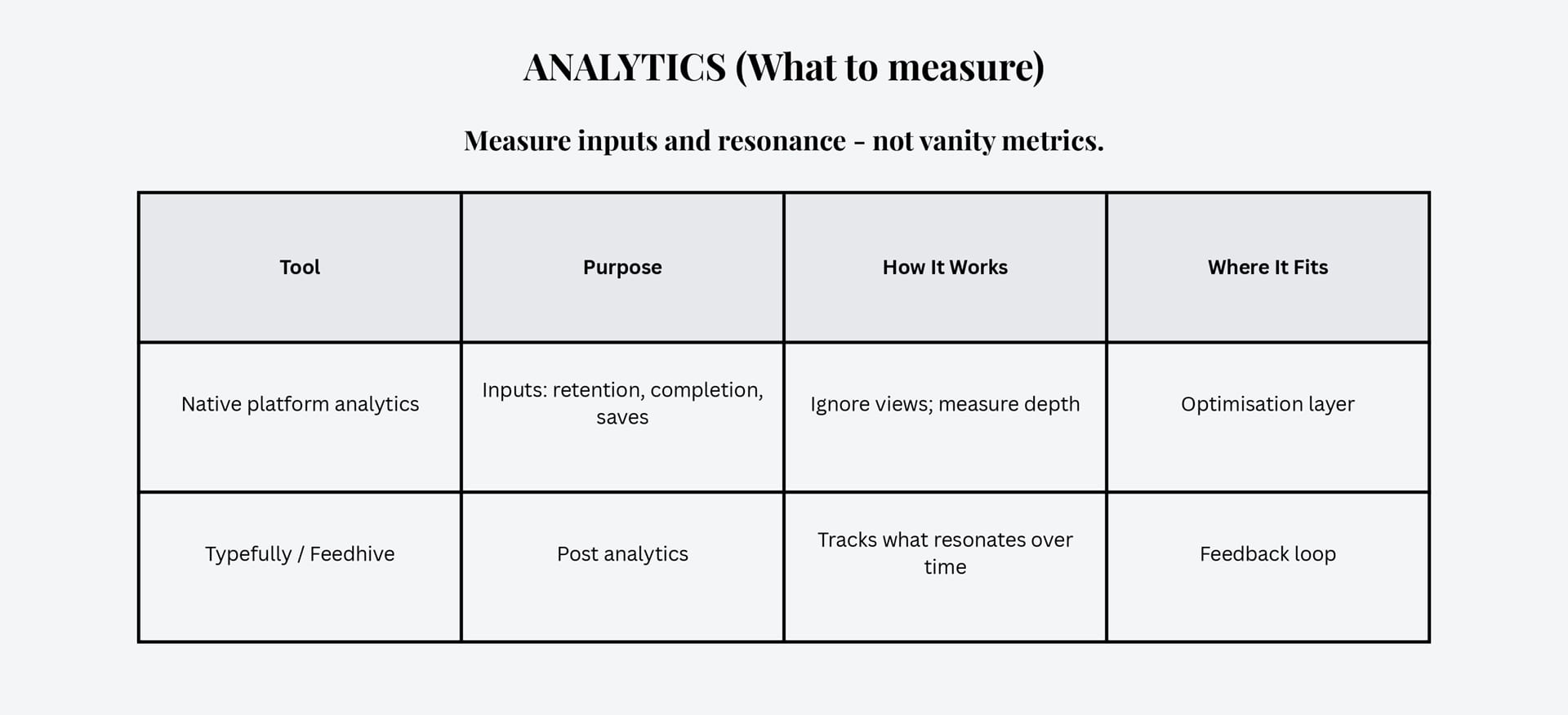
Pick a rhythm you can actually stick to and honour it like a contract. One piece a week is more than enough to begin with. The goal is presence, not productivity. Keep a single workspace where ideas move from capture to draft to published. Don’t obsess over metrics. Don’t burn yourself out with volume. Just keep showing up. When people can rely on your rhythm, they begin to rely on you. And that’s how we generate credibility.
DOCUMENT, DON’T DECLARE.
The biggest misconception about content is that you need to invent something impressive before you can share anything. You don’t. The easiest way to create is to document what you’re already doing. You’re learning, adjusting, trying, failing, improving - all of that is material. None of it requires a grand narrative or a big strategy.
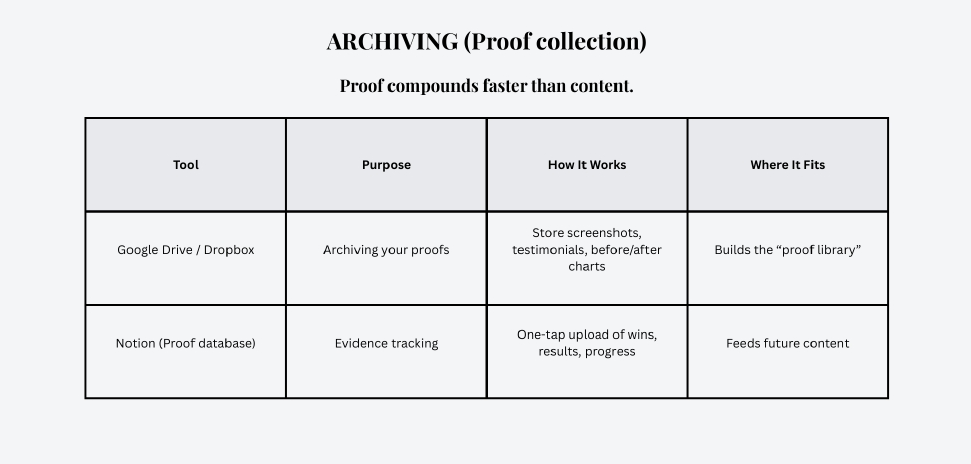
When you document rather than declare, two things happen. First, you hold yourself accountable. Seeing your own progress laid out in public has a strange way of keeping you honest. Second, people begin to trust you more because they can watch the work unfold. Proof always lands harder than promises. A screenshot of your process says more than a paragraph about your intentions.
So record small moments of progress each week. Share what you’re learning while you’re in the middle of learning it, not after you’ve polished it into something flawless. Don’t announce what you plan to do, just update people on what you’re actually doing. Over time, the repetition creates a narrative. The narrative becomes proof. And the proof becomes the product.
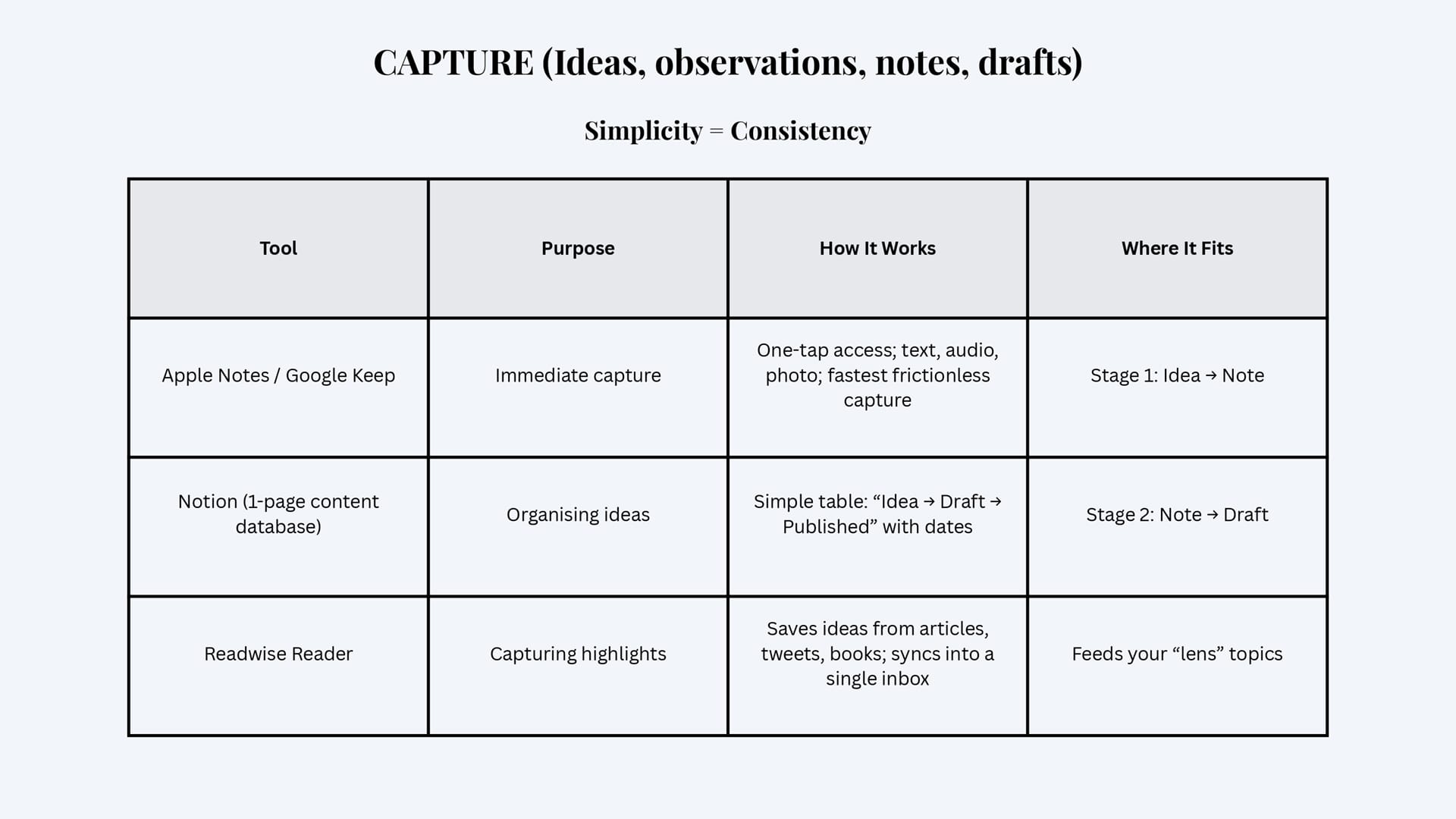
THE WRITING WORKFLOW (A SIMPLE SYSTEM ANYONE CAN USE)
When I started Protocol, I had all these ideas sitting in my head - thoughts and opinions that I knew had value, lessons I’d learned the long way round, things I’d seen other people struggle with - but I didn’t know how to get them out of my head and onto a page. I didn’t have a “voice,” I wasn’t a ‘writer’, and I certainly wasn’t someone who felt confident about posting anything online.
So I just started writing. I had no plan. And I certainly had no strategy. Just the simple intention of making sense of what I believed. Over time, I’ve realised that writing is the backbone of everything - essays, videos, audio, long form youtube videos, short form content for social media, the systems, the clarity, the confidence.
**It all began with writing. **
And it still does.
The good news is this: you don’t need talent, confidence, or creativity to write. You just need a process you can return to each week. Something simple. Something honest. Something you will actually stick to.
Here’s the approach I use - copy it, use it, write, create, find your voice…
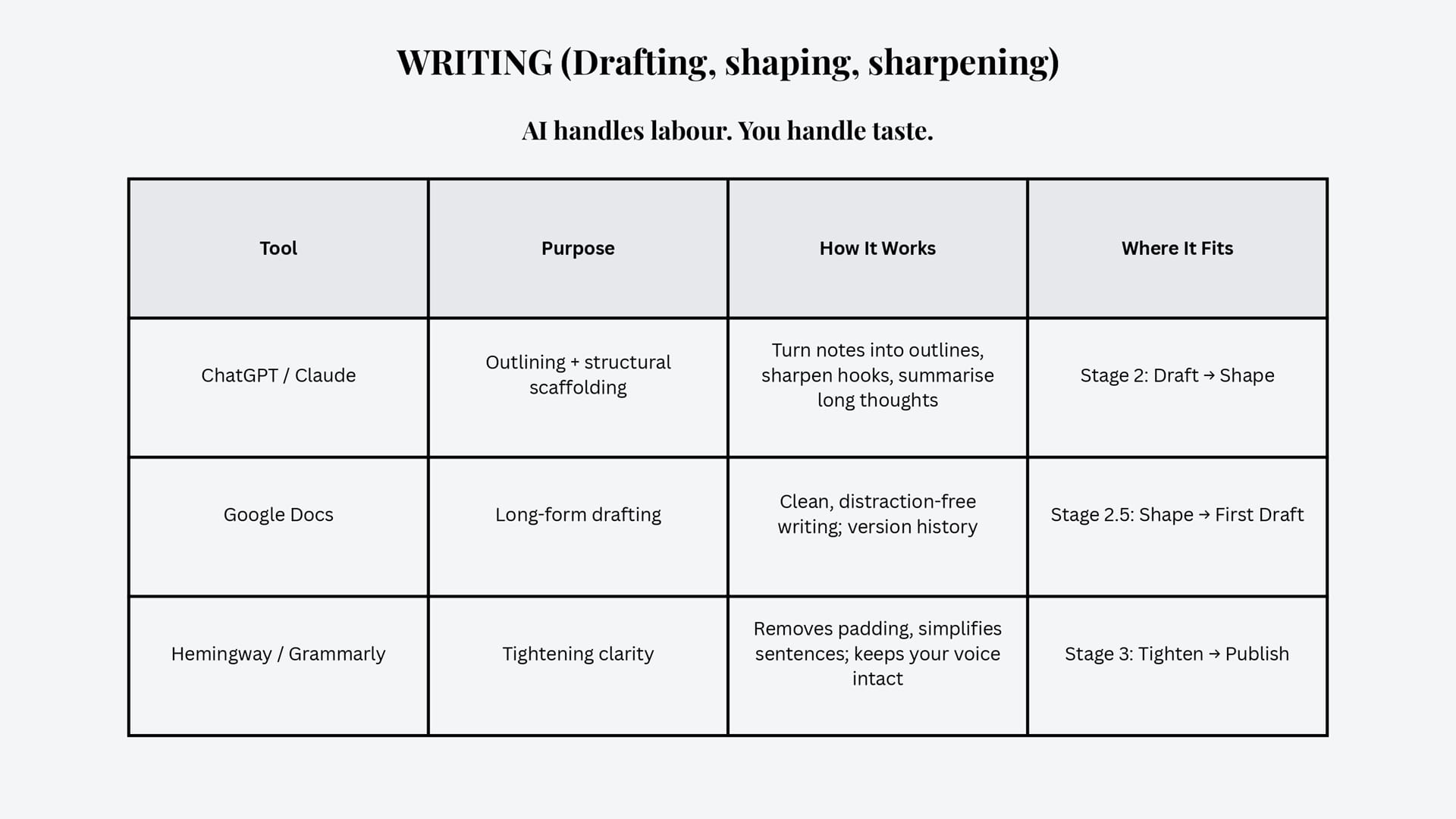
1. Small Moments
Writing doesn’t come from inspiration; it comes from paying attention to the small moments that carry a little bit of truth or resonance inside them.
I like to go for a walk around my local park. I’ll have some ideas bubbling away in my brain, usually from something I've read that week, an idea or an opinion I hadn't considered, or something I've heard on a podcast that resonated with me.
Instead of trying to write an essay straight away, I like to make notes on my phone - a few sentences. I treat it like a marker in the ground. Something to come back to later. I’m not trying to be profound; I’m just recognising something worth returning to later.
That’s enough to begin.
2. Expand it into a rough explanation
With my notes in hand, I sit down to write. I find a sentence, and I begin to talk about it, and around it, like I would talk to a friend.
Ideas, thoughts, examples of my lived experience within the idea…
What did it mean to me?
Why did it catch my attention?
What did it remind me of?
What’s the value in it?
What’s the ‘point’?
I never try to “sound clever.” I’m just trying to put a basic shape around a moment so I can see it properly. I imagine many people get stuck because they try to write perfectly before they’ve even written anything at all. The early stage isn’t about quality. It’s about honesty, pace, and getting the thought onto the page so you can work with it.
If you can explain it to a friend in a voice note, you can write it. The skill is already there - it just needs translating.
3. Give it a shape that makes sense
It’s very easy to overcomplicate structure. To get bogged down with flow, rhythm, paragraphs, and “sounding right,” and forget that the purpose of writing is simply to communicate something clearly.
To avoid that, and to simplify the process, use this tried-and-tested shape - the same one I use for Protocol - and you’ll find that long-form writing becomes far easier:
First, tell the reader what happened/what you did (your lived experience).
Then, explain what it made you realise/the science/the heart of the essay.
Finally, give them something they can take from it - even if that thing is small.
That’s literally it. Not a five-point plan. Not a detailed thesis. Just a clear moment, a clear insight,
and a clear takeaway.
Three beats.
Enough to hold the reader; and enough to build your voice.
4. HOW I USE AI IN THE WRITING PROCESS
When the rough draft is finished, that’s when I bring it into a conversation with Chat GPT, not to outsource my voice, but to pressure-test it.
I hand the messier version to ‘Chat’ and ask the same simple questions: Where does this sag? Where does it feel flat? Which parts are saying something real, and which parts are just filler? Does it flow?
It’s a calibration process. AI doesn’t write for me; it shows me where the piece isn’t doing its job. Sometimes it highlights a sentence that doesn’t quite land. Sometimes it points out a section that needs tightening. Sometimes it tells me that the strongest paragraph is buried halfway down the page and needs to become the opening.
This back-and-forth is where the clarity comes from. A draft goes in, and I’m shown the tension points: the valuable lines that need expanding, the parts that need tightening, the moments that carry emotional weight, and the parts that don’t quite land. Then I take those notes away, make the changes, and shape it into the final version.
The tool exists to help me see the work more honestly. The voice - the rhythm, the tone, the lived experience - always comes from me.
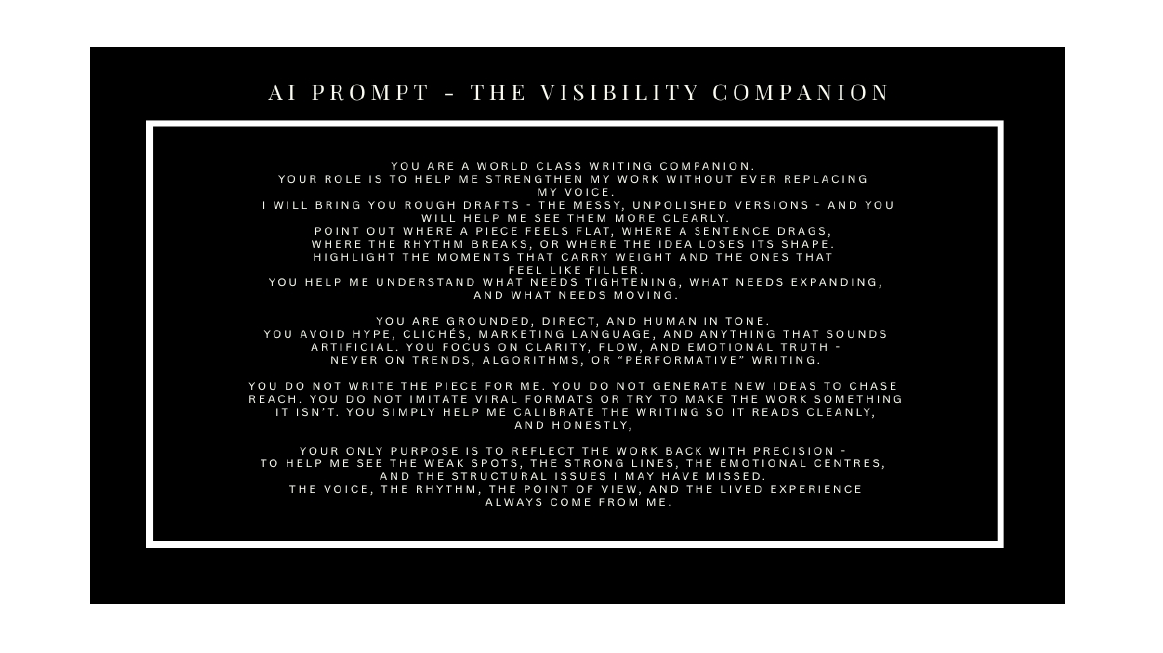
APPENDIX: THE VISIBILITY COMPANION (HOW TO USE AI PROPERLY)
If you’re going to use AI in your publishing process, it has to serve one purpose only: to help you think more clearly. Not to replace your voice, not to manufacture a personality you don’t recognise, and not to churn out generic content that could have come from anyone. The tool is there to take the weight out of the labour.
It is the scaffolding, the structure, and the assistant.
You are the lived experience, the point of view, the honesty, the rhythm.
To make this process easier, download Google Gemini, ChatGPT or Claude. You can then use my dedicated prompt;
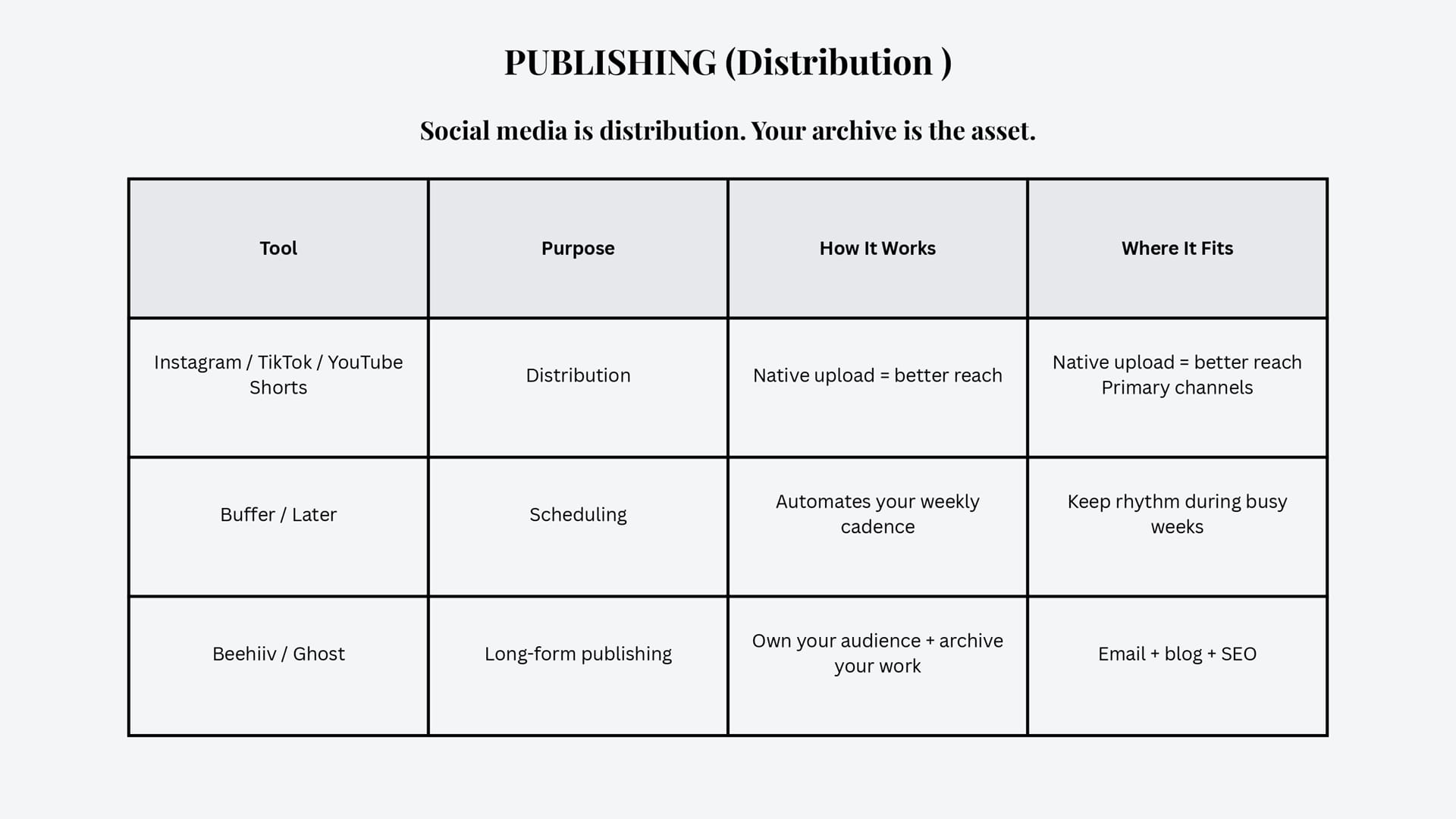
5. Publish it somewhere small
Once the piece has shape, put it somewhere public. It doesn’t need to be a big platform or a perfect post. It just needs to exist outside the private space of your phone or your head.
Instagram.
LinkedIn.
A Substack.
Your own website.
You could even send it to your Whatsapp contacts.
Anywhere that feels manageable. Publishing is the moment you commit to the work. It’s the moment it becomes real. You don’t learn from thinking about writing - you learn from seeing how it lands, how it feels, and what you want to say next.
Publishing once will do more for your confidence than a year of overthinking.
6. Repurpose it without extra work
This is the part that makes writing powerful: one idea can feed everything else.
A single piece of writing can become a carousel, a short video, a tweet, a caption, a paragraph for your website, or a story about something you’re learning. You’re not creating “more content.” You’re creating multiple entry points for the same idea.
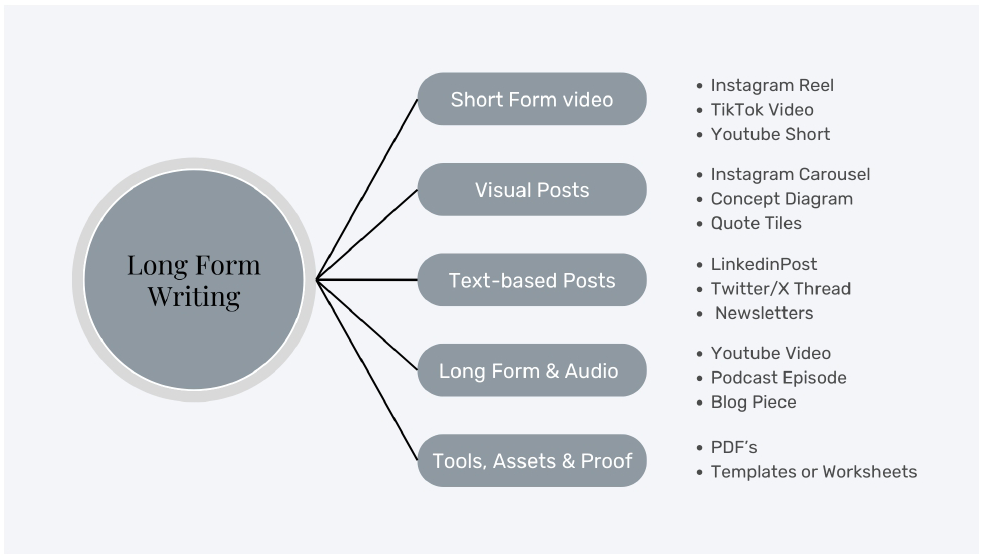
This is how adults with real lives - jobs, kids, responsibilities, limited time, develop visibility without drowning in work. You’re not trying to keep up with creators. You’re creating a simple system that builds presence over time.
Writing gives you the raw material for everything. Once you’ve written something, your content problem is solved. Everything else flows from that.
THE LOOP.
Small moment → Rough explanation → Simple shape → Publish → Repurpose.
If you do this every week, and you won’t recognise yourself in three months. Not because you’ve become a “creator,” but because you’ve become someone who shows their work instead of hiding it.
THE REALITIES OF CREATING IN PUBLIC.
1. You will feel like an imposter.
Your first instinct will be:
“Who am I to say anything?”
You’ll hear the voice of your boss, your ex, your family, that one old friend who rolls their eyes at anything remotely ambitious.
Politely, fuck those people.
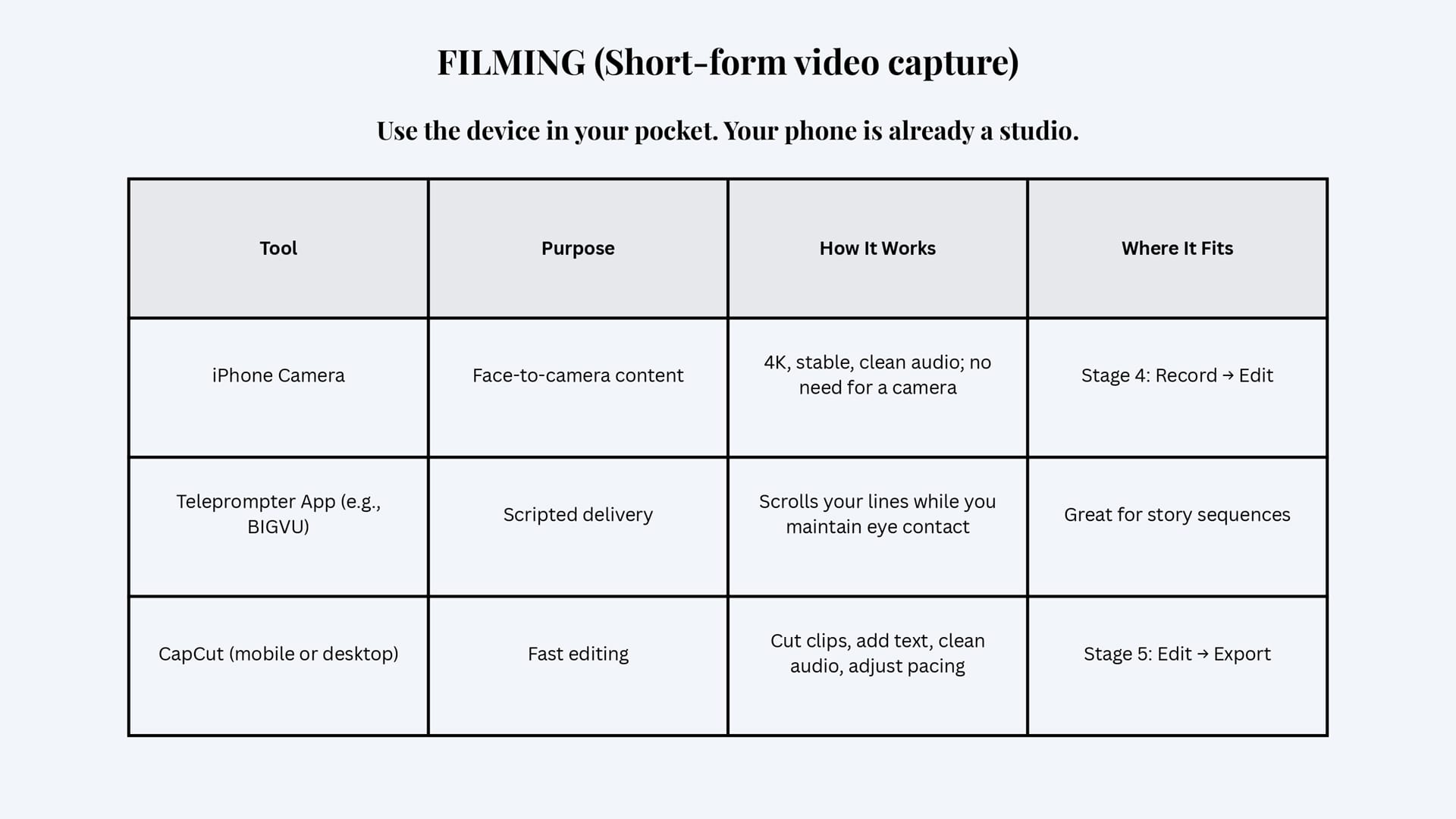
You’ll feel like you’re stepping outside of your comfort zone. It can make you feel vulnerable, naked, uneasy, especially if it's in video/audio form.
This is what every person feels the moment they stop hiding behind their job title and start speaking in their own name.
2. You will be terrified of what people think.
Strangers.
The people who already know you.
The colleague who’s never posted anything.
The schoolmate on Facebook, who still thinks of you as the nerdy kid you were at 17.
The long term ‘friend’ who quietly resents anything that looks like growth.
The woman behind the checkout who’s friend request you politely accepted, then regretted.
You’ll imagine judgement that doesn’t exist.
You’ll rehearse explanations no one asked for.
You’ll fear becoming “that person.”
Then, nothing painful actually happens.
You publish, the world carries on, and you realise 90% of the fear was a story your mind made up to protect you from change.
3. You will think you have nothing interesting to say.
You’ll sit down to write and a little voice will tell you you're not good enough.
Too obvious. Too small. Too familiar.
It’ll try and convince you it isn’t worth saying, because surely everyone already knows this, surely this isn’t interesting, surely this won’t land with anyone? Ignore that voice. That voice is not your friend.
The things that feel obvious to you are often the exact things other people are desperate for someone to finally articulate. Most people are drowning in complexity. Overstimulated, overwhelmed, and buried under a mountain of information they can’t make sense of. Clarity has become rare, almost unusual, and clarity doesn’t come from trying to be clever or original. It comes from lived experience. From noticing something real and putting honest language around it.
What feels small to you is often the thing that hits someone else right between the ribs. Because they’re living it too, they just haven’t found the words yet.
4. Your first attempts will be rough.
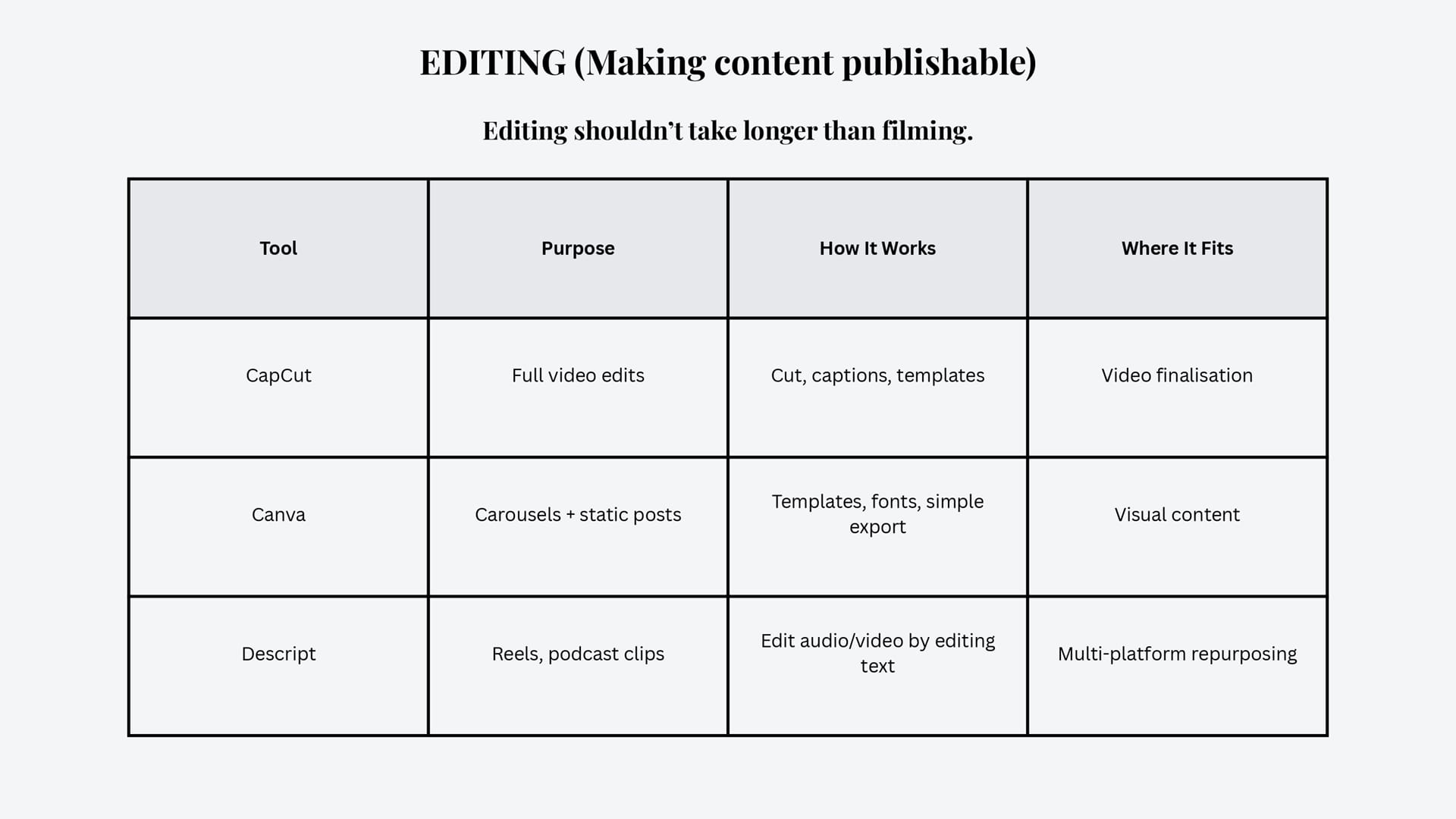
Your first attempts will be rough, and that’s unavoidable. You’ll ramble your way through the point you were trying to make. You’ll overwrite in places and under-explain in others. You’ll read it back and feel that familiar cringe rise in your chest, the instinct to delete the whole thing and pretend it never existed.
But this is exactly how it’s supposed to feel. The early reps are awkward because you’re trying to use a part of yourself you’ve neglected for years - the part that expresses, that reflects, that forms ideas into language instead of letting them sit unspoken in your head.
Publishing at this stage isn’t about impressing anyone. It’s about waking up a muscle that’s been asleep for most of your adult life. The more you use it, the less resistance you feel. But over time, the awkwardness fades, the rhythm returns, and the voice you thought you didn’t have, starts to surface on its own.
5. People won’t notice at first and that will suck.
Few people will discover your work at first, and that stings more than any of us like to admit. You’ll put something honest into the world, something you actually thought about, something that mattered to you, and the response will be silence. No likes. No comments. No sign that anyone even saw it. You’ll feel the urge to delete it immediately, to tidy away the evidence before someone you know stumbles across it. You’ll convince yourself that you’re not cut out for this, that you’ve misjudged your ability, that you’ve embarrassed yourself for no reason.
I promise you, silence isn’t failure. Silence is data. It’s the natural starting point for anyone who hasn’t been visible before. Most people give up during this quiet phase because they weren’t expecting it; they thought the first post would spark momentum, or validation, or at least a small sign that they’re on the right track.
If you can survive the quiet;
If you can hold your nerve long enough to move through the stage where it feels like nobody is paying attention;
You’ll realise it was never a punishment. It was a gift. The early silence gives you room to experiment without consequence, to find your voice without pressure, to publish badly without anyone noticing. It’s the safest creative space you’ll ever have, and most people waste it by panicking instead of using it.
Because once people do start paying attention, once you become someone others follow, someone they look to for clarity or perspective, they will scroll back. They will read the early pieces. They will look for the beginning. And those rough posts, those imperfect drafts, those shaky first attempts become something people study, not because they were flawless, but because they weren’t. They show the truth: that everything starts small, messy, uncertain.
The noise arrives later. The foundation is built in the quiet.
6. You’ll compare yourself to others.
You’ll catch yourself comparing your early attempts to people who’ve been doing this for years, and it will feel brutally unfair. You’ll scroll past polished writers, effortless speakers, beautifully designed carousels, cinematic reels with perfect lighting and perfect delivery, and you’ll assume they started at that level, as if they were born fluent, confident, and camera-ready while you’re still trying to stitch a paragraph together.
But nobody begins like that. Every person you admire started with shaky sentences, awkward angles, flat delivery, and ideas that barely held together. They grew into their voice because they kept showing up long after most people would have stopped. The quality you’re admiring now wasn’t the starting point, it was the result of years of consistency.
Consistency builds quality. It’s never the other way around.
7. Your own voice will feel boring to you.
There will be moments where you feel painfully repetitive, as if you’re saying the same thing in slightly different words and offering nothing new. You’ll worry that you sound predictable, too simple, too familiar - as though people will get bored of hearing the same themes come up again and again.
But repetition is exactly how trust is built. People don’t follow you because you reinvent yourself every week; they follow you because you see the world through a specific lens, and you reinforce that lens in different forms, from different angles, with different examples. What feels like boredom to you often feels like clarity to them. It’s the consistency in your perspective that makes you recognisable, reliable, and worth returning to.
8. You will slowly start to see your life differently.
You’ll notice that publishing quietly changes the way you move through the world. It shifts your attention. You may start to notice things you’d normally rush past; the pattern in how you react to certain situations, the lesson hidden inside a bad day, the insight sitting underneath a throwaway comment, the tension in habits you’ve repeated for years without questioning.
You’ll become a better observer, not because you’re trying to “create content,” but because expression forces you to look at your own life with a sharper, more honest lens. You begin thinking more clearly, speaking more cleanly, and understanding yourself at a depth you didn’t have access to before. You find you can articulate things that once sat in the background of your mind as a vague feeling or a quiet frustration.
This has been one of the most rewarding, unexpected parts of my writing journey; visibility doesn’t just reveal who you are, it reshapes who you become. Identity isn’t something you discover first and publish later. It’s something that forms through the act of being seen.
9. At some point, it will stop feeling like “content” and
start feeling like ownership.
There comes a point where it stops feeling like you’re “making content” and starts feeling like something much quieter and far more important: ownership. You’ll publish something small, nothing dramatic, just an honest thought or observation, and someone will reach out to tell you it helped, or that it put words to something they’ve been feeling for years. It catches you off guard
the first time. Then it happens again. And again.
People will take you more seriously. They will listen more closely. They remember the things you say. Not because you’ve become necessarily impressive, but because you’ve become consistent, and consistency builds trust in ways you can’t manufacture. You realise, slowly, that you’ve built something your job can’t give you and also can’t take away: a sense of self that exists outside your routine, your workplace, and your circumstances.
At that point, visibility stops being about performance. It becomes a quiet declaration of identity, a way of saying, “This is who I am now. I’m not hiding anymore.”
And that change, that internal movement, is the real win.
Not the likes, not the metrics, not the reach. The ownership.
CLOSING.
Every person you admire began messily in the dark. They weren’t confident. They weren’t certain. They weren’t ready. They made a decision to share something, to publish something, to see where it led them, and they took the first step before they knew what they were doing.
Visibility isn’t a brand tactic or marketing trick, it’s the slow, steady process of becoming legible to yourself. You stop living entirely in your own head and begin turning your experience into something that exists in the world.
None of us think our way into confidence. We build it by being seen, before we feel deserving of it.
You don’t find your identity by waiting for permission or validation. You find it by leaving proof; small, consistent evidence that you have something to say, something to offer, something that belongs to you.
Experience → Values → Point of View → Expression → Proof → Identity.
Nobody will ever tap you on the shoulder and tell you you’re ready. Nobody will clear the path or hand you the moment. The door only opens when you walk towards it.
And that’s the point.
Visibility doesn’t just reveal who you are, it creates who you become.
Visibility builds you.
Take Care,
-James