What If You've Outgrown Your Life?

I sat down with a friend of mine recently for a long overdue catchup. He’s good company - thoughtful, likes a beer, loves the football, runs his own business, devilishly handsome - we sure do have a lot in common.
Some people need to be gently coaxed into a deeper conversation, and so, after we’d broken bread and discussed the main headlines from our lives, I asked him how he was ‘in himself’. He paused for a second longer than normal and replied, "Yeah, everything's fine. I’m very comfortable."
Comfortable.
He said it the way you'd describe a hotel reception at a Travel Lodge. Adequate. Functional. Nothing to complain about.
There was, however, something loaded behind the word ‘comfortable’ that caught my attention.
He said it three times, actually. Everything was “comfortable”. Over the course of maybe forty minutes, that word kept reappearing, as if it were the only one available to him. For context, he has a good job. A wife he loves. A child. A nice house. His car is German and expensive. He travels. He eats well. The kind of life that, if you described it to a stranger, would sound enviable. To be clear, he isn't ungrateful or in any form of crisis. He's just a bit, well, flat. I recognised a lifelessness to his tone, whilst not depression exactly, sounded more like someone describing a life they're watching from behind frosted glass rather than actively participating in.
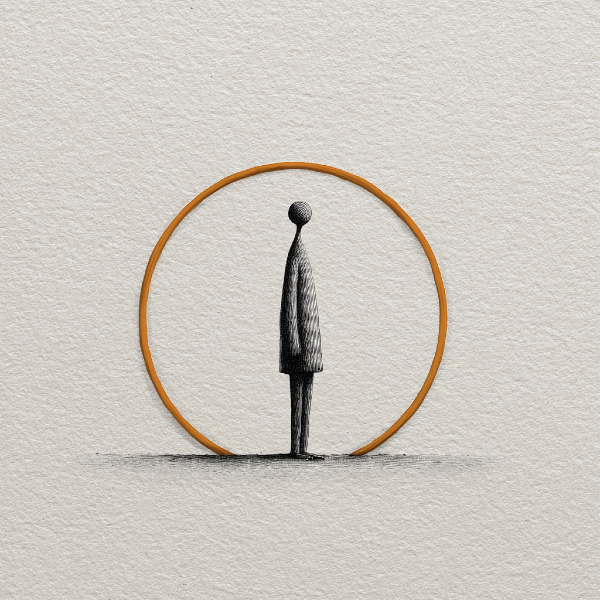
I didn't give him any advice, or dig, or push, I simply listened. But afterwards, driving home, I couldn't stop thinking about the expression behind his eyes. Or rather, the absence of one. He looked like a man standing inside a finished building, realising he couldn’t remember why he built it.
I recognised it because I've been there, inside that same building, the same day repeating, over and over.
I think a lot of us feel like that…
You can do everything right. You can follow the sensible path, build the stable life, hit the markers that culture and family and common sense told you to hit, and still end up feeling a sense of unfulfillment.
Remember there was a plan, once.
You absorbed it young. Most of us did.
Get a decent job. Work hard. Push yourself. Excel. Find a partner. Settle somewhere. Get something stable. Don't take stupid risks. Be grateful for what you've got. Maybe buy a watch if things go well.
None of that was wrong, exactly. It kept you safe. It gave you structure and focus and a watch. Structure and focus are important. Watches less so.
At twenty-three, "get something stable" is a somewhat reasonable ambition. At thirty-six, it's more akin to a holding pattern. The version of you that designed this life was operating with less information, less experience, and more fear than the version that’s sitting here reading this. That version needed safety. This version needs direction. And the structure you built to serve one cannot accommodate the other without something starting to feel wrong.
Psychologist Kennon Sheldon's research on self-concordance explains that only goals that align with your actual, current values produce sustained wellbeing. Goals you pursue because they were expected of you, or because a past version of you chose them, produce what Sheldon calls "introjected motivation." You keep doing the thing. You keep showing up. But the effort doesn't return anything emotionally. You feel disciplined and empty at the same time. It’s bollocks, quite frankly.
A structural mismatch between who you are now and what your life was designed to contain.
Rarely feeling like a problem, Comfort is the most effective anaesthetic available to adults. It removes friction, momentum and diligence, which I must admit, sounds almost desirable until you realise these elements are the things that force us to confront ourselves.
When life is uncomfortable, we’re forced to make decisions. To evaluate. To confront. To choose. When life is comfortable, days can pass without a single moment that demands you to ever be fully present. You can run on autopilot from Monday to Sunday without ever making a decision that matters, only noticing you’ve been doing it when something demands your immediate attention.
A monotonous suffering. Adequately paid. Scarcely challenged. Never reaching the threshold where action becomes necessary.
Psychologists have referred to the midlife psychological challenge as "generativity versus stagnation," which I really like. The concept is simple; at a certain point in adulthood, maintenance can no longer be enough. You need to feel that you are building something, contributing something, moving toward something that matters beyond your own routine. You desire some living. If that need goes unmet, when your days are full but ultimately purposeless and leave you unfulfilled, stagnation and resulting loss of colour will have you telling people you’re “comfortable”.
When this feeling gets loud enough that you can't ignore it, the instinct is almost always the same; change something external.
New job. New town or city. New partner. New hobby. New wardrobe. A course. A side project. Something that introduces a novelty flavoured dopamine spike to the brain and tricks the nervous system into thinking progress is being made.
I know people who have done this repeatedly. Retrained in a completely different field. Cut off all contact with long term friends for no other reason than it felt momentarily exciting. Picked up hobbies with the kind of fervor that borders on the obsessive (are YOU playing padel every week to compensate?) And yet they still feel exactly the same.
You can redecorate a house you’ve outgrown and it will still be the wrong house. It'll just have better curtains.
The mistake I see is treating the external elements, let’s call them ‘containers’ - the job, the city, the relationship, the routine, as the source of the problem. Which they obviously aren't. They're symptoms. The source is the operating system underneath, the mechanism under the hood, the set of assumptions, the defaults, and inherited ideas about what your life is supposed to look like that you've never revisited because you've been too busy living.
I call this identity lag. Through experience and regret and observation, your values, standards and your sense of what is important, has updated, but the structure of your life is still running on the old version. You're trying to live a 2026 existence inside a framework you designed, or absorbed, ten+ years ago, with less data and knowledge and more fear than you have now.
And because the framework technically works fine, you never feel justified in questioning it.
I suffered from identity lag from 2021-2025. The job that doesn't energise you. Friendships that feel like never ending admin. Weekend rituals that once felt grounding now feel like community service. Sunday evening hovering somewhere between dread and boredom, a low hum of resistance toward a week that hasn't even started yet. I would find myself irritated by things that shouldn't bother me. Snapping at partners over nothing. Losing patience in long queues. Scrolling until midnight, not because anything on the screen was of interest to me, but because putting the phone down meant being alone with the feeling.
I’d rather be numb than honest.
What makes identity lag dangerous is precisely what makes it survivable. It’s possible to languish for years. You can build an entire decade around it. Two decades even. You’ll occasionally catch a sigh, or smile at a memory of when you were full of living, and feel a pang that something, somewhere, went wrong - the feeling leaves before you act upon it of course, replaced by the aforementioned comfort. Best put the kettle on then…
The End (beginning).
Which parts of this life belong to who I am now, and which parts belong to someone I used to be?
You can’t fix this with a new five-year plan or a vision board or a dramatic life overhaul. You fix it by being honest about which parts of your current life were designed by the person you are now, and which parts are still obeying instructions from a version of you that no longer exists. Some of those instructions came from your parents. Some came from your social environment. Some came from fear, or class, or the specific postcode you grew up in and the ceiling it placed on your imagination without you noticing.
And some of them, perhaps the hardest ones to confront, came from you. From decisions you made in good faith, with the best information you had at the time, that were absolutely right for the person you used to be. They just aren't right anymore. And continuing to honour them out of loyalty to a past self feels a strange form of self-betrayal, masquerades as consistency.
Not all of it is outdated. Some of it, the inspiring relationships, the commitments, the routines that genuinely serve you. Keep those. They're load-bearing.
But the containers - the job you stay in because leaving would mean admitting it wasn't right for you in the first place, the social obligations you maintain because you've always maintained them, not because they inspire or nourish you, and the version of yourself you perform in public because it's the one people recognise, that shit needs to be addressed.
What I’m ultimately suggesting is a series of small, specific decisions that bring the external structure into alignment with the internal reality. One boundary drawn. One commitment questioned. One awkward conversation. One hour per week reclaimed for something that excites you, would be a start.
You know what you need to do.
You've known for a while.
Take Care,
-James