Why Are We Optimising Everything Except The Bit That Actually Matters?

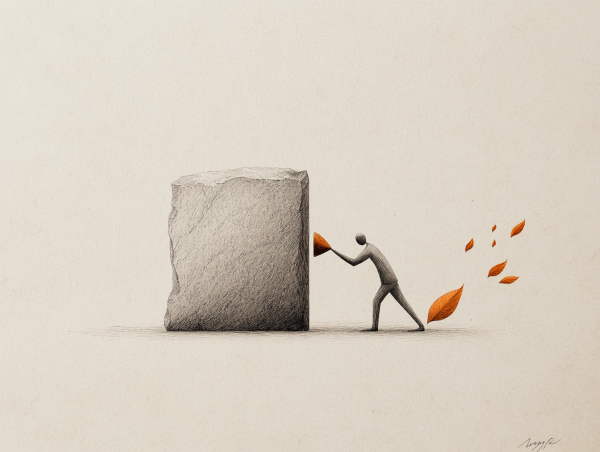
A few weeks ago I had a really fucking good day. By anyone's standards, a real zinger.
I won't go into the specifics (yet), but an opportunity came through that I'd been working toward for a while. The kind of moment that warrants a bottle of something decent. So I opened the cupboard, reached for a bottle of red (a Chateau La Lagune 2014) that I'd been saving, poured a single glass, stood in my kitchen, and drank it. Alone. Then I popped the cork back in and sat back down.
The next time I had cause to open that cupboard (another win, a week later), the wine had gone bad.
I'm not sure I've ever been handed a metaphor quite so efficiently...
Let me first be really clear about where I'm coming from, because this letter isn't what you think it is.
I am not about to tell you that the single life is a problem that needs solving, or that building something in private is somehow less valid than building it with an audience of one. I've spent the better part of eighteen months deliberately outside of the dating scene, and it has been, by almost every measure, the most productive period of my adult life. My mornings are mine. My evenings, also mine. My attention goes where I direct it, without negotiation, and without the kind of low-level noise that comes with maintaining closeness to another person. My output has been, quite frankly, obscene. I've written more in eight months than most people manage in five years.
I'm telling you this so the rest of the letter lands correctly. The life is working fine. That's not the issue.
The issue is the wine…
More than half of singles say they're burned out on dating right now. Nearly half are taking a deliberate break. The reasons are legitimate and widely understood - apps designed to maximise engagement rather than connection, a culture of performance masquerading as vulnerability, the sheer accumulated exhaustion of presenting yourself as a viable option to strangers who are also presenting themselves as viable options. It makes sense to step back from that. It also makes sense to redirect the energy towards something positive and personal.
And so a generation of people, mostly functional, mostly self-aware, mostly doing the work, have arrived at the same conclusion; focus on yourself first. Build the life. Become the person. Everything else will follow.
It's sensible advice for sure. And it has produced real results. Gyms are full of people executing it perfectly and newsletters like this one exist largely because of it.
But the framework has a blind spot, and the blind spot is this; there is no framework for what happens when the building phase is done.
Or more precisely, it has no answer for what the building is actually for.
There's a version of the "work on yourself" framework that functions, if you're honest about it, as a very sophisticated reason to stay still. Not lazy, or avoidant in any obvious sense, but certainly indefinitely in preparation. The project is always in progress. The readiness is always pending. The life you're building is always one chapter away from being ready to share.
I'm not saying this is you. I'm saying it's worth discussing.
Because the framework is structurally closed. It has no failure condition. There's no point at which you can demonstrate that you've been using it as cover rather than scaffolding, because the scaffolding is always justified - there's always another thing to build, another habit to shore up, another version of yourself to consolidate. The work is never finished, so the postponement is never quite visible as postponement.
If that makes sense?
What it produces is people who are impressively self-sufficient and genuinely uncertain about what they're self-sufficient for.
Which brings me back to the cupboard.
The loneliness researchers (ironically more of them now than there used to be, lol), have identified something they call the sharing effect. The experience of something good, shared with another person, produces a measurably more positive effect than the same experience enjoyed alone. Not slightly more. Significantly more. The win itself is not the full event. The telling of it is part of the event. The glass raised across a table at someone who was also invested in the outcome is as important as the event itself.
What this means, practically, is that a life optimised entirely in private is running at a structural deficit that no amount of personal achievement can address. You can hit every target, keep every promise, fill every hour with something benefical, and still find yourself standing in a kitchen with a single glass, wondering who you built this all for.
This is not a mood. It's not a bad day. It's the framework revealing what it was never designed to carry.
Here's what I think actually happened, firstly to me, and I imagine, to a lot of people reading this.
The "work on yourself first" model arrived at exactly the right time, and solved exactly the right problem. It gave people permission to stop performing availability and start building something real. That was useful. For a lot of people it was necessary.
But somewhere in the execution, the means became the end. The building became the point. And the question of what the building was for, who it was for, stopped being asked, because the asking felt like weakness, or neediness, or a regression to the kind of thinking the whole project was designed to escape.
We got terribly good at not needing anyone.
And not needing anyone turns out to be its own kind of trap.
The self-improvement industry will not tell you this, because it has no product for it, and it makes poor business sense, in the same way that dating apps have no monetory incentive to help you find love. There is no course on how to let someone matter to you. There is no protocol for allowing your wins to require a witness. There is no framework for the specific vulnerability of saying, “Hey I built this, and I want to share it with you..”
That territory is outside the system. Which is precisely why the system never mentions it.
Please know, I'm not suggesting you download an app. I'm not suggesting the answer is urgency, or that the solitude was neccasarily a mistake, or that you should be anywhere other than where you are.
I'm simply asking you a question, and I'd like you to sit with it rather than answer it immediately.
Is the life you're building - the structure, the mindset, the body, the output, the discipline, the compound interest of all those kept promises, being built toward something? Or has the building itself become the thing you do instead of [answering that question?]
Why are we optimising everything except the bit that actually matters?
I think it’s a question worth asking.
Take care,
- James